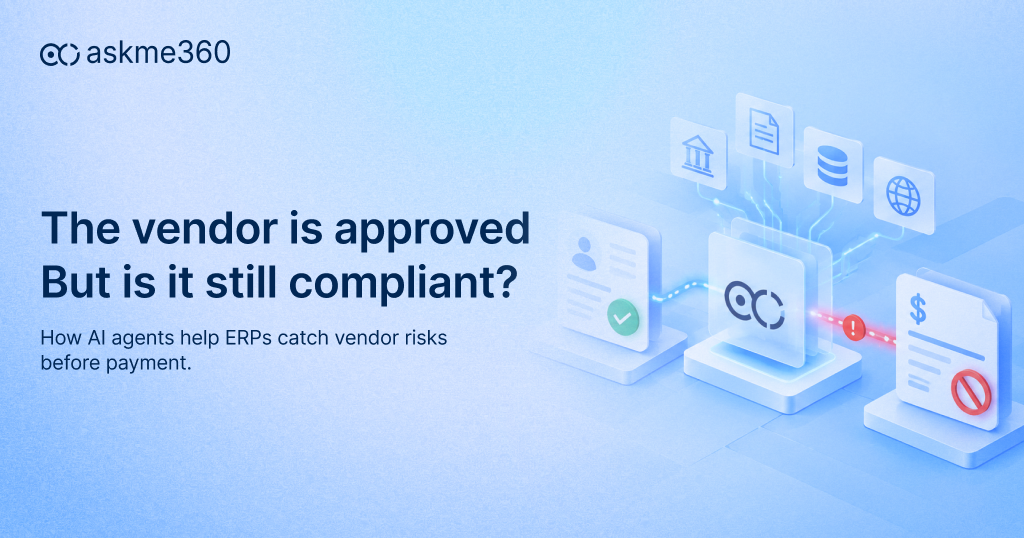
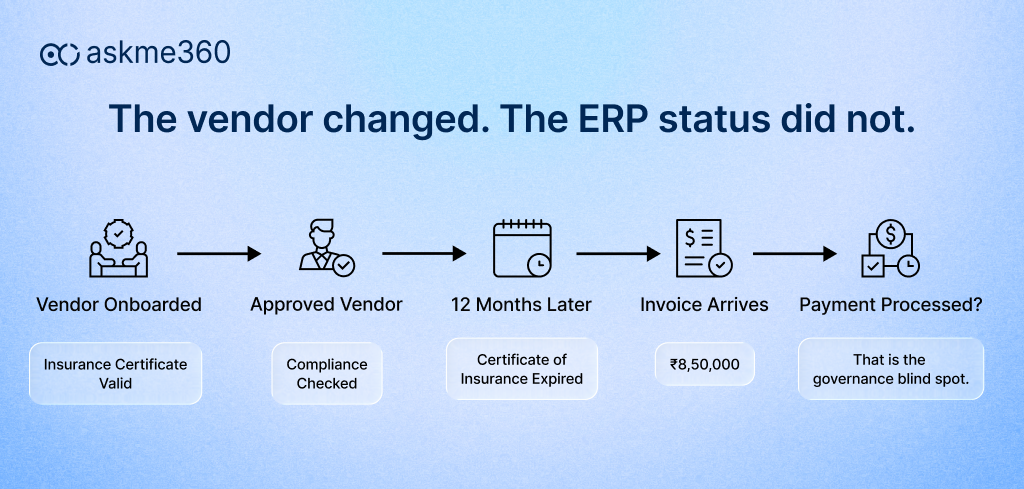
“You approved that vendor ages ago, but what could go wrong?”, It turns out, quite a lot. In today’s fast-moving enterprises, it’s all too easy to approve a supplier once and then forget about them. But vendor compliance isn’t a one-time checkbox. Insurance policies lapse, licenses expire, security certifications fall out of date and nothing in a traditional ERP vendor management system will stop the invoices. By the time Accounts Payable is about to cut a check, the “risk file” for that vendor may be months out of date. The result is a hidden governance blind spot. Vendor compliance management and vendor risk is top-of-mind for C-suite risk leaders in 2026.
Vendor risk management is now the leading concern entering 2026, ahead of even financial or operational risk. Yet most companies still rely on point-in-time vendor questionnaires and static records. As risk ledger puts it, traditional third-party risk management is like “inspecting the locks on a vault door once a year, while attackers test the fire exits continuously”. In other words, by the time a vendor’s compliance lapses, it may already be too late.
What is Vendor Compliance Management?
Vendor compliance management is the continuous process of monitoring third-party suppliers and vendors, ensuring they comply with regulatory, legal, contractual, financial, internal policies, and compliance requirements throughout the vendor cycle. This also includes validating and imposing these standards across several domains like procurement, finance, and legal.
Why is Vendor Compliance Management important for enterprises?
Because third-party failures are already costing companies millions. In 2024, 30% of data breaches involved a third-party vendor, double the share from the prior year. Companies have thousands of vendors; a study by Dynamic Business found the average organization manages almost 286 vendors but only a handful of risk managers on the job. Few organizations maintain real-time monitoring of that sprawling vendor base.
The result is only about 22% of firms have operational vendor risk metrics , and hardly any have continuous monitoring in place. In short, companies think they know their suppliers but much of the network lies in darkness.
“Compliance documents can expire or fall out of scope without alert,” warns one supply-chain report. Yet without automated tracking, finance teams usually assume compliance remains valid. Only when an invoice reaches the payment run does the issue come to light often triggering last-minute freezes and finger-pointing.
Why can approved vendors become non-compliant over time?
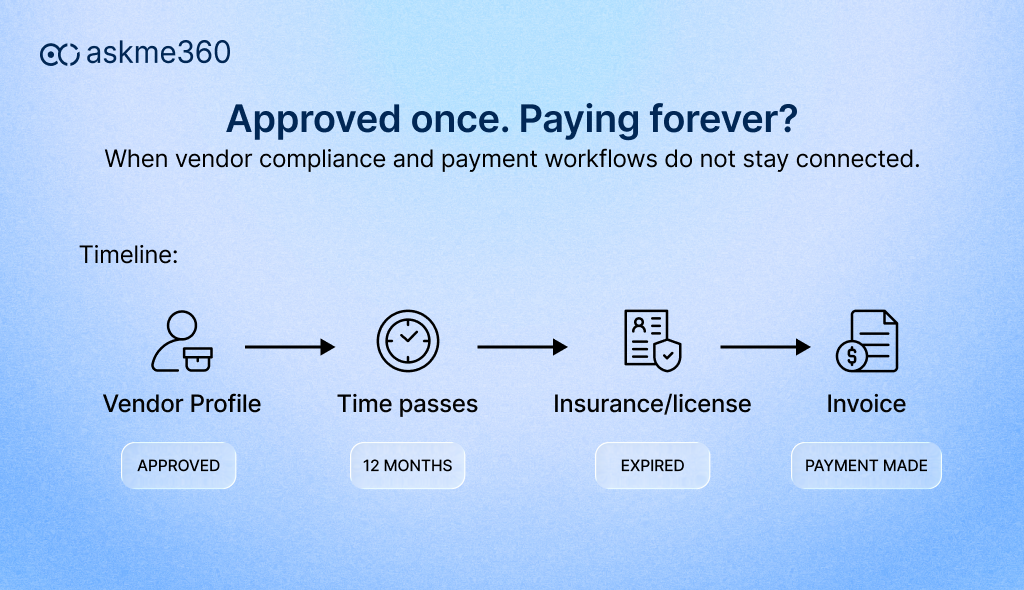
Most ERP systems and manual processes operate on a simple premise, once a vendor is approved and set up, they stay “active” in the system until someone intervenes. The ERP remembers that approval, but it has no concept of expiry. Accounts Payable clerks will happily pay invoices to that vendor unless a person raises a flag. In practice, that means-
- Initial vetting only – Finance or procurement checks a vendor’s credentials once while onboarding, then files them away.
- Passive compliance – There is no ongoing check. An insurance certificate that was valid at onboarding can lapse a year later with no event in the ERP.
- Payment on autopilot – When bills arrive, the system doesn’t cross-check them against current compliance status; it just releases payment as usual.
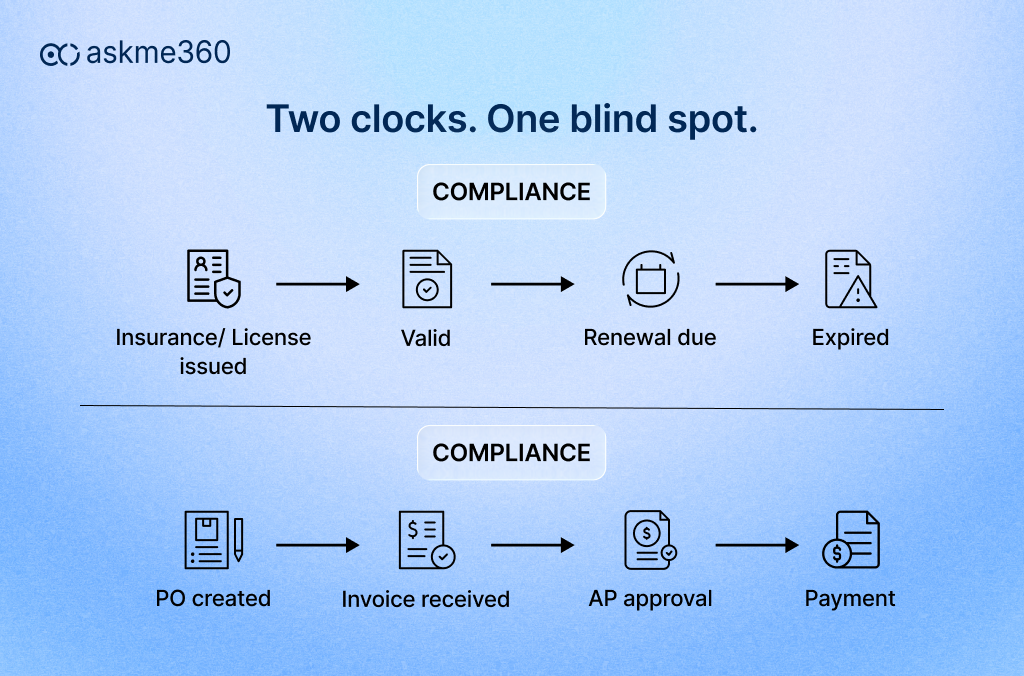
It’s like approving a parking permit and never checking if it renews. The vendor gets a lifetime pass unless someone manually intervenes. This one-time mindset is the root of the blind spot. As a recent industry blog noted, “compliance lives on a different clock than invoices”. Contracts, policies and certificates renew on their own timelines, disconnected from billing cycles. So, without active monitoring, a vendor might quietly slip offside of regulations or contract terms yet still get paid in full.
What happens when vendor compliance expires?
The delayed discovery of compliance gaps and dismantled vendor payment controls have very tangible consequences:
- Financial penalties – In many industries, paying a non-compliant vendor creates immediate audit and insurance liabilities.
- Operational disruption – When AP freezes a payment, project managers and field teams suddenly have subcontractors walking off the job or refusing to supply materials until paid.
- Relationship headaches – Vendors hate unexpected holds, and without clear reasons they assume the worst. The siloed process of vendor billing often makes an enforcement arm of compliance, a role that can erode trust and require time-consuming explanations.
Why vendor compliance is a cross-functional business priority?
Vendor compliance is not just a finance problem. It is a whole-business problem wearing different hats. Procurement brings the vendor in. Legal sets the rules. Compliance keeps an eye on them. Information security checks the digital risk. Finance and Accounts Payable handle the money. Vendor owners rely on the supplier to keep things moving. And senior management ultimately needs to know whether all of this is under control.
Here is where each team comes in:
Procurement and vendor owners – “We approved them. Are they still good?”
Getting a vendor through onboarding is only the first step. Procurement and vendor owners need visibility into whether their licenses, insurance, certifications, and other requirements are still valid. Otherwise, an approved vendor can quietly become a non-compliant one while everyone assumes business is as usual.
Finance and Accounts Payable – “Should we actually pay this invoice?”
AP sees the invoice, but the invoice does not tell the whole story. If a vendor’s compliance status has changed, finance needs to know before the payment goes out. Otherwise, the problem can surface only when someone is already trying to release the money.
Legal and compliance – “Are they still meeting the rules?”
Legal and compliance teams define many of the requirements vendors need to meet. But a requirement sitting safely inside a contract or compliance checklist is not much help if nobody knows when it expires or whether the vendor still meets it.
Information security – “They have access. Is that access still safe?”
Vendors with access to company systems or sensitive data can create a different kind of compliance risk. Security certifications, assessments, and access requirements can change over time. A vendor being approved last year does not automatically make them compliant today.
C-suite – “How many of these are we actually watching?”
Leadership does not need another spreadsheet with 500 vendor names. It needs visibility into the bigger picture – which vendors have open issues, what is overdue, what could affect operations, and finally know where the business needs to act.
A vendor can be procured by one team, reviewed by another, paid by a third, and relied upon by five more. If all those teams are working with different pieces of information, a compliance lapse can easily slip through the cracks.
The goal is not to give everyone another dashboard to check. It is to make sure the right people know about the right problem before it becomes everyone’s problem.
How companies manage vendor compliance and third-party risk (and why they often don’t work)?
Most organizations recognize the issue eventually, and try to plug the gap but often with partial fixes.
- Vendor portals and spreadsheets – Some firms ask vendors to self-report expirations through a portal or maintain Excel trackers of renewal dates. In practice, spreadsheets grow stale and portals are infrequently used.
- Annual refreshes – Others do annual risk reviews, sending questionnaires or renewing contracts once a year. A vendor might pass the January survey and then drift out of compliance by March.
- Generic holds– Some AP teams resort to blanket holds on entire invoices if any doubt arises. This can at least stop payments, but it’s coarse. Without integrated tools, a blocked payment might just get stuck in limbo, with vague reason. Without detail, invoice holds become a black hole of inefficiency.
The ideal fix is a continuous, automated compliance check that is integrated with your payment process. But many companies lack integrated tools. Typical ERPs are great at storing vendor master data, but not great at dynamic checks and alerts.
How can AI agents for ERP improve vendor compliance monitoring?
The good news is that the technology to “close this loop” is now emerging through advanced vendor compliance automation. CFOs should consider shifting from reporting to intelligence not just reading static reports of vendor status but embedding compliance into the ERP/ERP-AI layer itself.
An ideal workflow should sound like –
- Unified vendor compliance record – Each vendor’s ERP record is continuously updated with compliance statuses (insurance, certifications, licenses, sanctions screening).
- Payment eligibility rules – The system knows the rules and these rules are tied to the vendor record.
- Automated holds and alerts – If a document expires, the AI flags the vendor as ‘payment on hold’ and prevents any matching invoices from being paid. It alerts finance and the vendor. If the vendor renews, the hold is lifted automatically.
- Clear reason codes and dashboards – Whenever a hold happens, the system logs exactly which requirement failed (e.g. “Expired COI as of June 1”).
How can enterprises build continuous vendor compliance into their ERP processes?
At the end of the day, vendors only remain “clean” as long as someone is watching them. CFOs and CEOs need to recognize that approval is not a perpetual safeguard. The governance gap in many modern ERPs is real, after the vendor is in, nothing stops a compliance lapse from turning into a cash and risk event.
Fortunately, the technology to fix this is catching up. By linking vendor compliance monitoring with payment workflows whether through specialized vendor-management platforms or the new breed of AI-assisted ERP agents like askme360, companies can ensure they only pay vendors who are in good standing right now. In practice, this means closing the loop between procurement, legal, and finance.
So, before the next invoice run, ask yourself – “Do we truly know which vendors might have “expired” and are we comfortable paying them by default?” If the answer gives you pause, it’s time to plug the gap. With continuous oversight in place, that silent compliance time-bomb becomes a solved problem and your finance team can move on from firefighting to focus on strategic questions.

How can askme360 support vendor compliance visibility in ERP data?
A complete accurate vendor compliance visibility is no longer a pie-in-the-sky. For example, askme360 operates as one of the most successful AI agents for ERP. The AI layer of an ERP like askme360 can be configured to answer queries such as “Show me all active vendors whose insurance expires this month” or “Hold payments for any vendor missing a current certificate.”
By embedding compliance checks into the ERP’s decision-making, companies turn vendor oversight from a manual burden into an automated control. Not just this, it can also act as an agent and take actions based on requirement. The results are dramatic- fewer surprise payment holds, cleaner audit trails, and ultimately less cash wasted on penalties or last-minute fixes. That kind of continuous process is exactly what erases the blind spot.
Frequently Asked Questions
What documents should a company collect from vendors for compliance?
Common vendor compliance documents include business licenses, tax registrations, insurance certificates, security certifications, regulatory permits, contracts, and other industry-specific credentials. As part of supplier compliance management, companies should also track each document’s validity period, renewal requirements, and the vendor’s overall risk profile.
Who is responsible for vendor compliance in a company?
Vendor compliance is usually a shared responsibility between procurement, finance, legal, compliance, and business teams. Procurement may manage onboarding, legal reviews contractual requirements, and finance oversees payment processes. A clear third-party risk management framework helps define these responsibilities and ensures compliance issues do not fall between departments.
How often should vendor compliance be reviewed?
Vendor compliance should be reviewed according to the vendor’s risk level and specific requirements rather than relying only on an annual review. High-risk or critical suppliers may need more frequent checks. Within ERP vendor management, companies can also track renewal dates and compliance events to identify issues before they affect business operations.
What is the difference between vendor compliance and vendor risk management?
Vendor compliance focuses on whether a supplier meets specific requirements, such as having valid licenses, insurance, or certifications. Vendor risk management is broader and considers financial, operational, cybersecurity, regulatory, and reputational risks associated with a supplier. Vendor compliance is therefore one important part of a wider risk management program.
What is a vendor compliance exception?
A vendor compliance exception occurs when a supplier does not meet a required compliance condition. For example, an insurance certificate may have expired, a required license may be missing, or a contractual requirement may not have been fulfilled. Companies can record these exceptions alongside vendor master data management records so they can be assigned, tracked, and resolved.