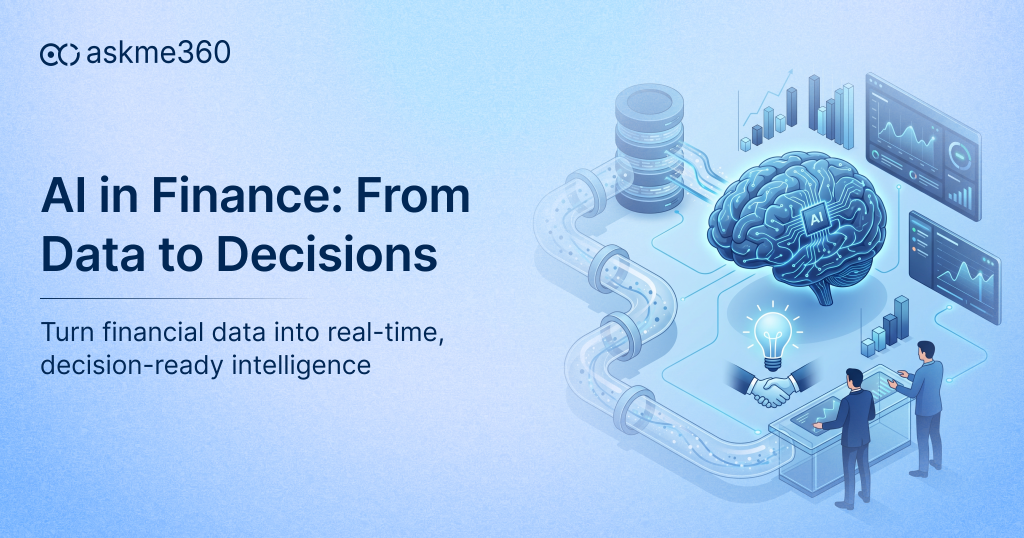
Finance doesn’t have a data problem. It has a decision problem.
Enterprises today generate more financial data than ever before. Every transaction is captured. Every system is integrated. Every report is available on demand. And yet, decisions are slow.
Teams wait for reports. Leaders wait for validation. By the time insights arrive, the business has already moved. This is the gap AI in Finance is closing. Not by improving reporting. But by removing the distance between data and decision.
Let us discover how!
Why AI in Finance is Critical for Data-Driven Finance
Look closely at how finance operates today. Data flows continuously. Decisions do not. There is always a delay between knowing and acting. That delay is rarely questioned. It is accepted as part of the process. However, in today’s environment, that delay is a liability.
Enterprises lose significant productive time every year simply waiting for usable insights. That is not an efficiency issue. It is a strategic constraint.
Traditional workflows depend on:
- Manual data consolidation
- Periodic reporting cycles
- Multiple disconnected systems
As a result, organizations lose significant productive time every year simply waiting for actionable insights. Because while your team is waiting:
- Costs are shifting
- Risks are evolving
- Opportunities are disappearing
This is why data-driven finance matters. AI eliminates the lag.
With AI, finance shifts from:
- Periodic reporting → Continuous intelligence
- Delayed insights → Real-time visibility
- Reactive decisions → Proactive strategy
The shift is simple. From reporting cycles to decision velocity. This is not incremental improvement. It is a structural transformation.
How AI in Finance Enables Enterprise Finance Intelligence
AI does not sit outside your finance stack. It sits on top of it, and changes how it behaves. At its core, AI in Finance combines machine learning, predictive analytics, and natural language processing to continuously interpret financial data. But the real impact is architectural. But the real advantage lies in how it integrates into your existing ecosystem.
AI builds a unified intelligence layer across systems like ERP, procurement, supply chain, and finance. This creates a seamless flow of information that powers enterprise finance intelligence. Not as dashboards. Not as reports. But as live, decision-ready insight.
In practice, this means:
- Data is analyzed continuously, not requested
- Patterns are surfaced automatically, not discovered manually
- Insights are delivered instantly, not compiled
- Questions are answered directly, not routed
This is what AI decision support looks like when it works.
Real-World Examples of AI in Finance
This is not future-state. It is already operational.
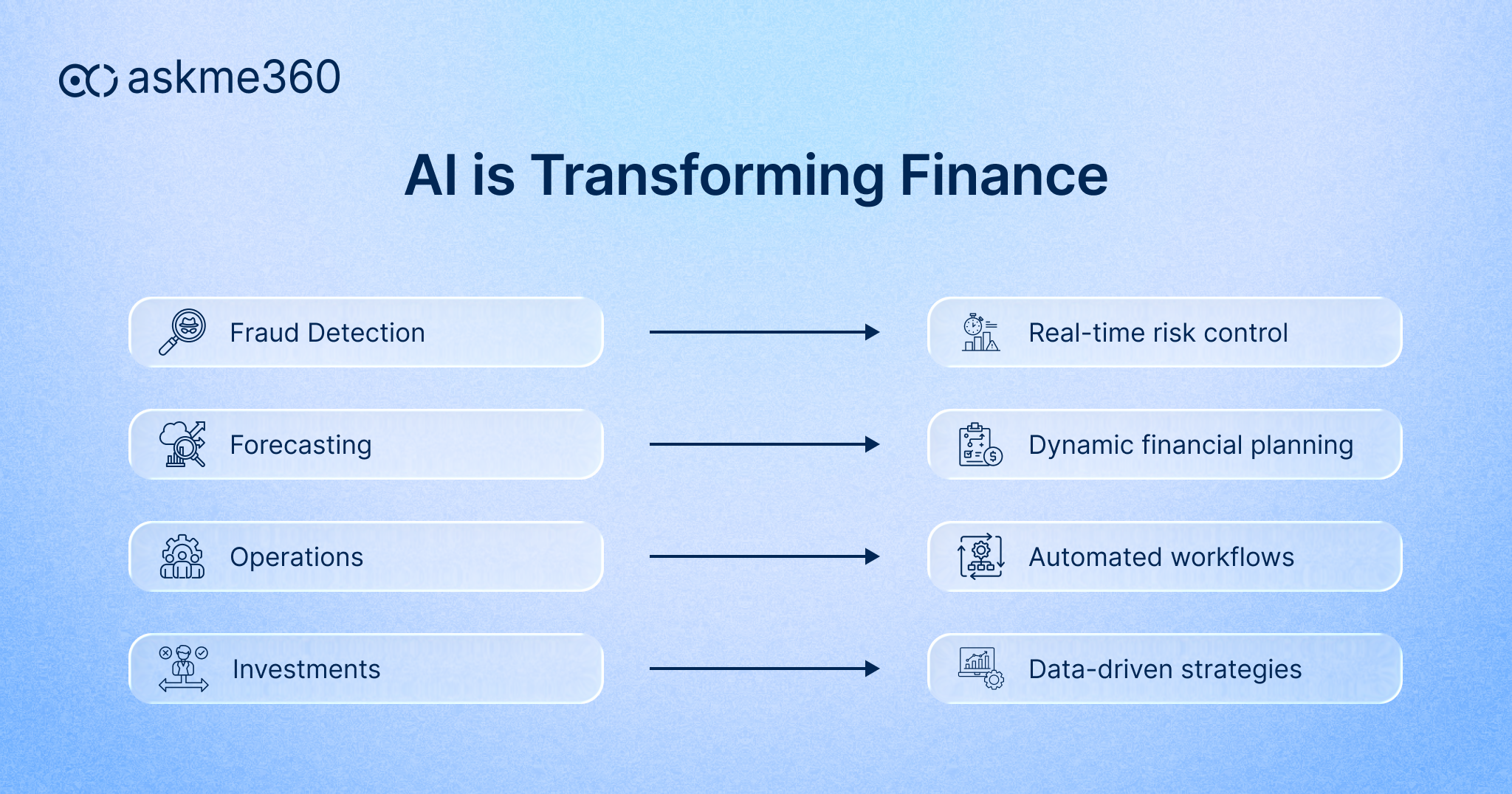
In Financial Planning and Forecasting, AI enables faster, more accurate forecasting and automated financial reporting, crucial for adapting to market fluctuations, says this Oracle article.
In fraud detection, AI systems monitor transactions in real time. They detect anomalies instantly and adapt to new fraud patterns dynamically. A large portion of financial institutions now rely on AI to manage this at scale .
In forecasting, AI replaces static models with dynamic systems. It continuously integrates internal and external data, cost inputs, demand signals, inflation trends, and updates projections in real time.
In Algorithmic Trading & Investment, AI accelerates high-speed trading and portfolio management, with tools like BlackRock’s Aladdin using NLP to analyze market sentiment, notes this YouTube video.
In operations, AI automates high-volume, repetitive workflows. Invoice validation, reconciliation, and compliance checks are executed with speed and precision.
In investment strategy, AI processes massive datasets to identify patterns and optimize portfolio decisions. Most asset managers are already moving in this direction .
And then there is the interface. Leaders no longer navigate systems. They interact with them. They ask:
- What is driving margin pressure?
- Where is cash flow at risk?
And they get answers, instantly. This is where financial analytics AI stops being analytical. And starts being operational.
Benefits of AI in Finance for Modern Enterprises
Most conversations around AI start with efficiency. That is the wrong starting point. Efficiency is a byproduct. The real value is control and clarity at speed.
AI enables:
- Faster decisions – Insights are available immediately, without dependency
- Higher accuracy – Reduced manual intervention minimizes error
- Full visibility – Data is unified across systems and functions
- Operational scale – Systems handle growth without added complexity
- Strategic capacity – Teams focus on decisions, not data preparation
Organizations already report measurable gains in productivity and execution speed when AI is applied to finance workflows. But the real advantage is not speed alone. It is consistently better decisions.
What Are the Risks of Not Implementing AI in Finance?
Most conversations around AI focus on implementation risks. Very few talk about the cost of inaction.
And in finance, that cost is not always visible immediately, but it compounds quietly. Delayed decisions, missed signals, and operational inefficiencies start to build up over time. The risk of not adopting AI in Finance is not just about falling behind on technology. It is about losing speed, visibility, and control when your business needs it the most.
Hence, the real risk is not adoption. It is delay.
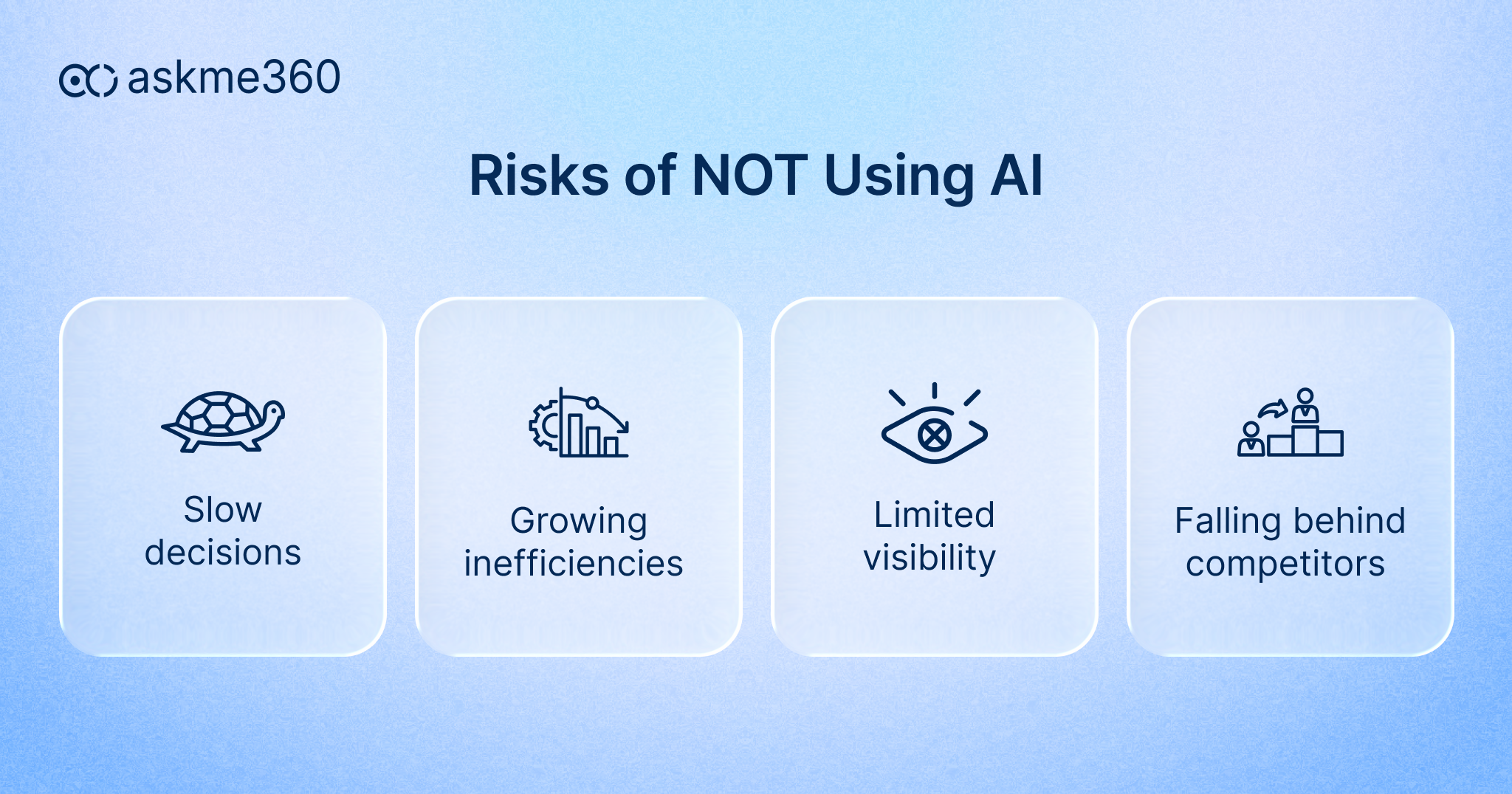
Decision Latency Becomes Structural
Without AI, finance continues to operate in cycles. Insight arrives late. Decisions follow. Over time, this becomes embedded in how the organization functions.
Inefficiency Scales with Growth
Manual processes do not stay contained. As volume increases, inefficiencies multiply—across reporting, reconciliation, and compliance.
Visibility Remains Fragmented
Without real-time financial insights, leadership operates on partial data. Strategy becomes reactive.
Competitive Position Weakens
Organizations that adopt AI operate faster. They respond earlier. They allocate capital more effectively.
Those that do not fall behind. Not gradually. Structurally.
Risks and Challenges Associated with AI in Finance
Despite its potential, AI in finance is not without its challenges. AI does not replace expertise. It amplifies it. AI introduces new capabilities. It also introduces new responsibilities.
And then there is the human aspect. As AI takes over routine tasks, the role of finance professionals evolves. Skills like data interpretation, strategic thinking, and cross-functional collaboration become more important than ever.
Integration Is A Necessity
Integration is another hurdle. Many enterprises still operate in fragmented environments, where data is spread across multiple systems. Bringing these together requires careful planning and execution. AI cannot operate in silos. It requires connected systems and unified data architecture.
Security and Compliance Are Foundational
Finance operates in a high-risk environment. AI systems must enforce governance, access control, and data protection by design. Cybersecurity remains a top concern for finance leaders. Security and compliance also come into sharp focus. Finance deals with sensitive data, and any vulnerability can have serious consequences. This is why governance, access control, and data privacy must be built into every AI initiative.
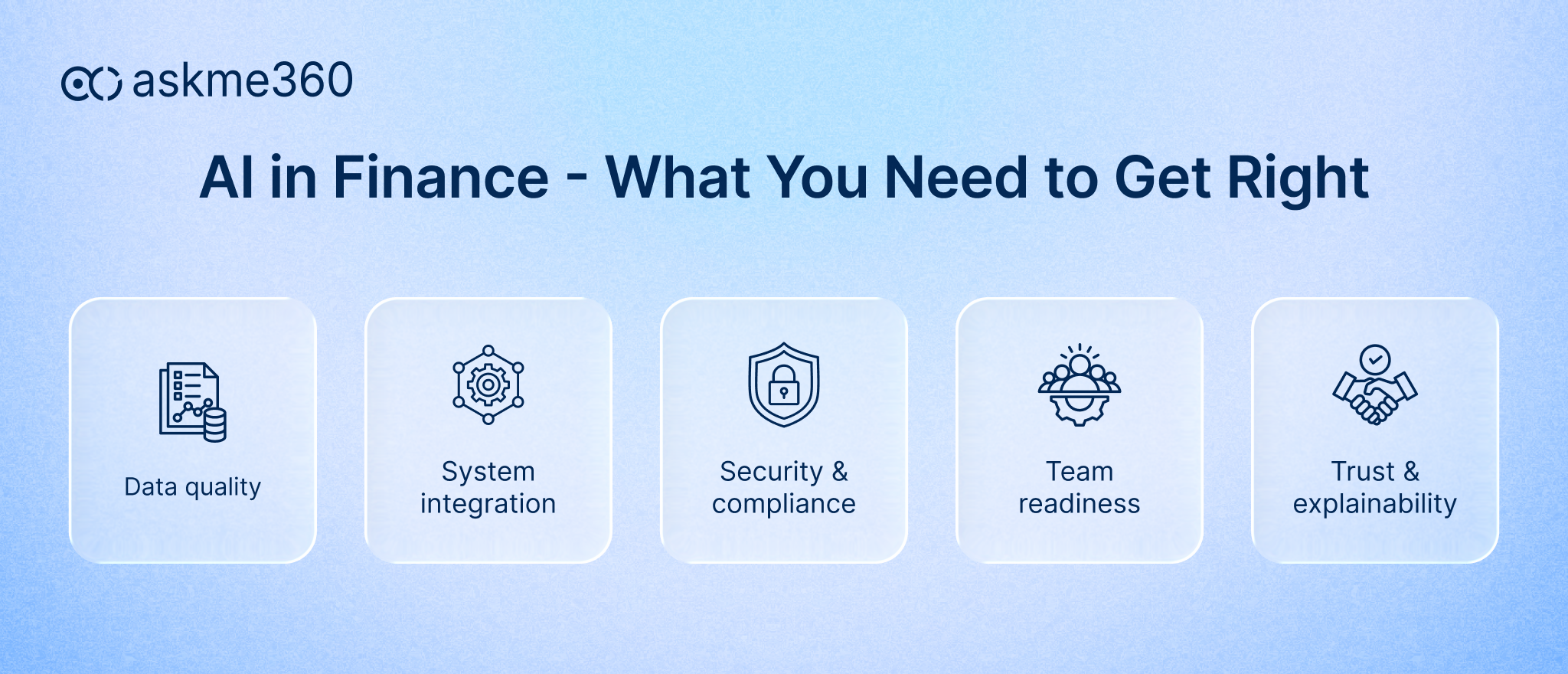
Teams Must Transition
And then there is the human aspect. As AI takes over routine tasks, the role of finance professionals evolves. Skills like data interpretation, strategic thinking, and cross-functional collaboration become more important than ever.
AI does not replace expertise. It amplifies it.
Trust Must Be Engineered
AI systems must be explainable. Leadership must understand not just the outcome—but the reasoning behind it. These are not barriers. They are design requirements.
Conclusion - Finance Becomes a Real-Time Decision System
Looking ahead, the trajectory is clear. AI is moving toward greater autonomy. Systems are being designed to not just analyze data but to execute decisions within defined parameters. These enterprise finance AI solutions are capable of managing workflows end-to-end, from data analysis to action.
A growing number of organizations are already exploring this shift. Autonomous agents, capable of handling complex financial processes, are becoming part of long-term strategies . This does not mean removing human oversight. It means redefining it.
Finance leaders will focus more on strategy, governance, and value creation, while AI handles execution at scale. From being just a reporting function, Finance is becoming a real-time decision system. This is the shift AI enables.
Without delay. Organizations that adopt this model do not just improve efficiency. They operate differently. They move faster. They see clearer. They decide earlier. That is the advantage.

HIPL and askme360
Heuristics Informatics Pvt. Ltd. (HIPL) brings over three decades of enterprise experience across ERP systems, data architecture, and digital transformation. This foundation has led to the development of askme360, an advanced AI-powered enterprise data agent designed to eliminate the gap between financial data and decision-making.
askme360 enables organizations to move beyond static reporting and adopt a model of true enterprise finance intelligence. It delivers real-time financial insights, enables conversational interaction with enterprise data, and automates complex reporting workflows.
By embedding AI decision support directly into financial operations, askme360 allows leadership teams to operate with speed, clarity, and control. For enterprises looking to implement scalable, secure, and high-impact enterprise finance AI solutions, HIPL and askme360 provide a system designed not just for insight, but for action.