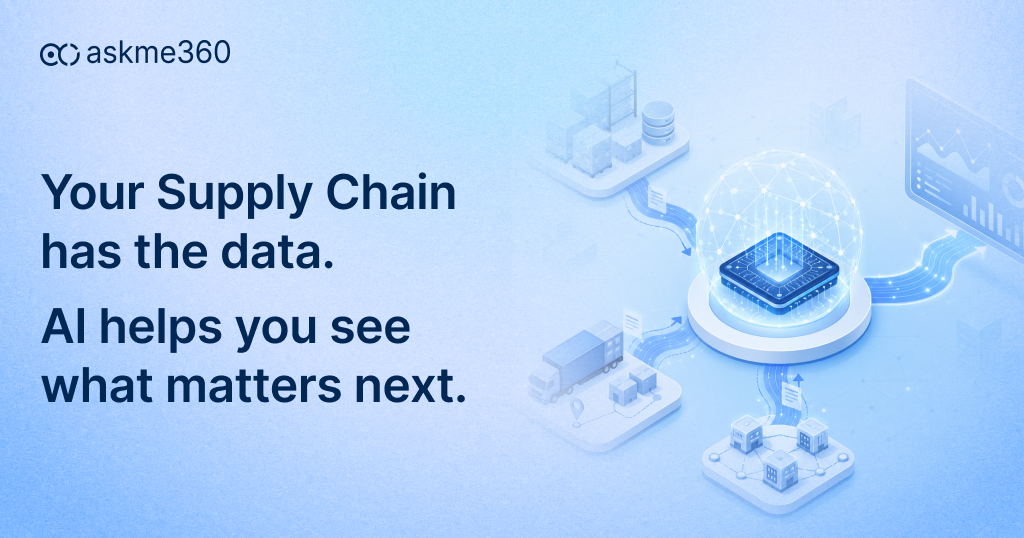
Your supply chain can look healthy on a dashboard while a disruption is already taking shape underneath it. A supplier may start missing delivery dates. A critical material may be running low. Demand may suddenly rise in one region. Or a shipment may no longer arrive when planned. Individually, these may look like small operational events. But when they connect, the impact can spread quickly across procurement, inventory, production, finance, sales, and customer delivery.
Data is not the problem. Actually, it is that enterprises often connect these signals too late. This is why AI in Supply Chain Management is moving higher on the enterprise agenda. AI can analyze operational signals across suppliers, procurement, inventory, orders, warehouses, and logistics to identify patterns and risks that traditional reports may not surface quickly enough. AI agents for supply chain take that intelligence closer to action by monitoring conditions, answering business questions, highlighting exceptions, and helping teams make faster operational decisions.
The investment momentum is already strong. Gartner reported in August 2026 that 67% of supply chain digital investment is being allocated to AI. Yet 55% of chief supply chain officers remain unclear about the ROI of those investments.
That gap captures the challenge facing supply chain leaders today. AI investment is accelerating. Measurable business value is not automatic.
Let us explore where can we add AI in Supply Chain and which supply chain decisions can AI help us make faster.
What is AI in Supply Chain Management?
AI in Supply Chain Management uses artificial intelligence to analyze operational data, identify patterns, predict outcomes, automate repetitive work, and support better decisions across planning, procurement, inventory, warehousing, logistics, and order fulfilment.
Traditional supply chain systems are very good at recording transactions. They tell you what was ordered, received, stored, shipped, and sold. AI adds a layer of intelligence to those transactions. It helps your teams understand what the data means and what deserves attention.
Instead of stopping at, “What happened?”, AI can help your teams ask:
- Why did it happen?
- What needs attention now?
- What could happen next?
- What should we consider doing about it?
For supply chain leaders, AI is therefore not simply about seeing more data. It is about making faster, data-backed decisions from the information the business already has.
Why do modern supply chains need more than just traditional reporting?
Modern supply chains need connected, near-real-time intelligence because operating conditions often change faster than traditional reporting cycles can keep up with. A weekly supplier report may be completely accurate and still arrive too late.
A monthly inventory dashboard may show that stock levels have declined. But operations teams need to know that a critical material is likely to fall below safety stock before production gets affected. The challenge becomes harder because supply chain data rarely sits in one place.
Procurement sees purchase orders and suppliers. Warehouse teams see stock and receipts. Manufacturing sees production requirements. Sales sees customer demand. Finance sees costs and working capital. Logistics sees shipments and delivery performance.
Each function may have a strong view of its own area. However, the most important business decisions often sit between these functions. That is why supply chain visibility now needs to mean more than knowing where a shipment or product is.
Businesses need to understand what is changing, why it matters, where the risk is building, and what needs attention first. The goal is not another dashboard full of KPIs. It is a connected operational view that helps people make better decisions.
How do AI Agents for Supply Chain Management work?
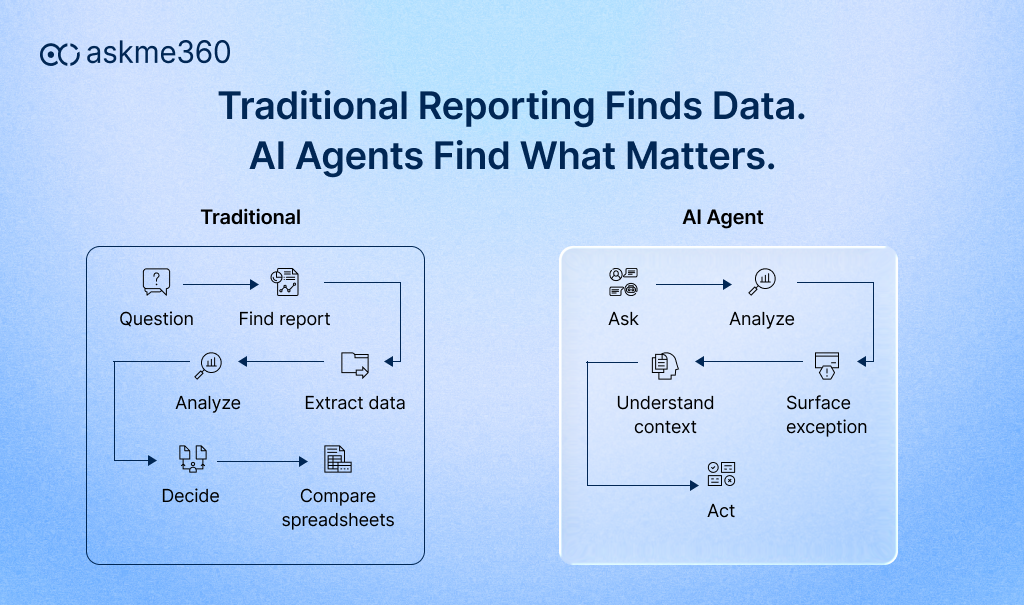
AI agents for supply chain can use enterprise data, business rules, models, and contextual reasoning to monitor situations, identify exceptions, recommend actions, and support approved workflows.
This makes them different from a basic chatbot.
If you ask:
“How much inventory do we have for Component A?”
A chatbot may respond:
8,500 units.
That answer is useful, but incomplete. It does not tell you whether those 8,500 units are enough.
Now if you ask an AI agent:
“Could Component A create a production risk next month?”
To answer properly, the agent may need to consider a number of factors and data.
The answer could then look very different:
“At the current consumption rate, Component A may fall below required stock in 18 days. The next purchase order is due in 22 days, while this supplier has averaged a four-day delay across the last six deliveries.”
That is not a simple database lookup. It is operational context. And context is what turns supply chain data into a useful business decision.
Gartner expects agentic capabilities in supply chain software to grow rapidly. It forecasts spending on supply chain management software with agentic AI capabilities to rise from less than $2 billion in 2025 to $53 billion by 2030.
The direction is clear. Enterprises are beginning to move from software that simply waits for instructions toward systems that can increasingly identify where attention is needed.
This is where Financial ERP data security, role-based access control, and audit logging in AI become business-critical. Protecting financial ERP data in the AI era requires a multi-layered approach that applies your existing financial ERP data security clearances to dynamic AI interactions. Because AI can inadvertently expose, manipulate, or synthesize data, ERP data security must be embedded directly into the application layer, restricting what AI models can access, process, and generate.
How does AI improve Supply Chain visibility?
AI improves supply chain visibility by connecting operational signals and highlighting the issues that matter most, instead of asking teams to manually monitor thousands of transactions.
Consider an enterprise managing thousands of purchase orders, supplier commitments, inventory positions, customer orders, and warehouse movements every day. The value of AI is not in showing every transaction. It is in identifying the few that need attention.
A delayed purchase order matters much more when it contains a component required for tomorrow’s production run. A stock reduction becomes more important when no replenishment is due before the safety-stock threshold is reached. AI can connect these events and provide the context behind the alert. This makes real-time supply chain insights useful. They help teams understand not only what is happening, but also what deserves attention now.
Walmart offers a practical example. The company has been expanding AI and automation across its supply chain to improve demand prediction, inventory movement, waste reduction, and coordination across markets.
The lesson applies far beyond retail. Better supply chain visibility is not about showing managers more information. It is about helping them see important changes early enough to respond.
How can AI improve Inventory Analytics?
AI-powered inventory analytics can help businesses identify shortages, excess stock, slow-moving inventory, changing consumption patterns, and replenishment risks earlier.
Inventory management has always been a balancing act. Too little inventory can lead to stockouts, production interruptions, and missed customer commitments. Too much inventory ties up working capital, increases storage costs, and raises the risk of obsolescence. AI can bring several variables into the same decision.
For example:
Current stock + historical demand + open orders + consumption + supplier lead time + incoming POs + seasonality
Together, these signals provide a much richer view than a basic stock-on-hand report.
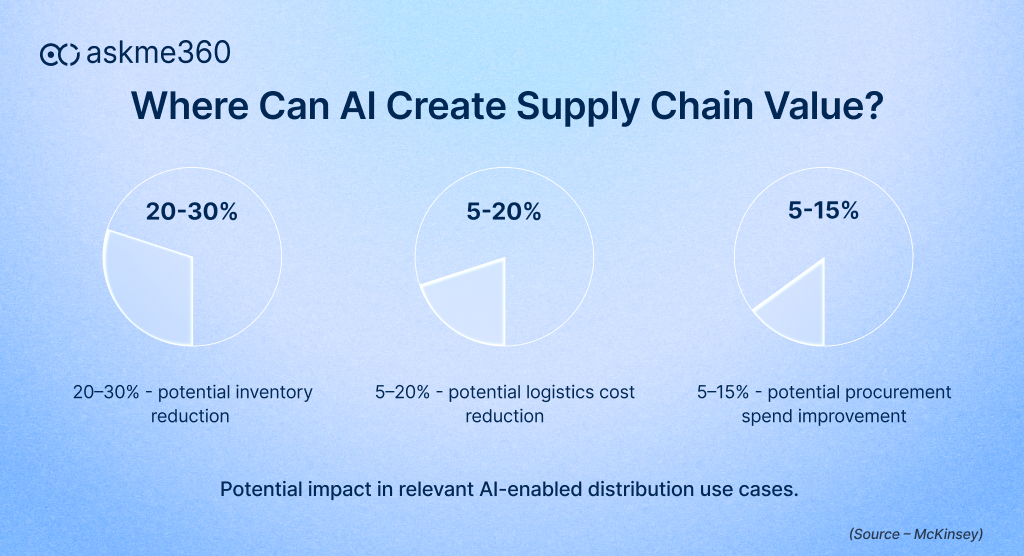
McKinsey estimates that AI applications in distribution can reduce inventory levels by 20% to 30% through better forecasting and optimization. It has also identified potential logistics cost reductions of 5% to 20% and procurement-spend improvements of 5% to 15% in relevant use cases.
How does AI improve Procurement Analytics?
AI-powered procurement analytics helps teams understand supplier performance, purchase-order delays, spending patterns, pricing movements, sourcing risks, and exceptions faster.
Procurement generates a large amount of useful data. It also creates a considerable amount of repetitive analytical work. Teams spend time comparing suppliers, following purchase orders, checking delivery performance, reviewing price changes, preparing spend reports, and chasing exceptions. AI can reduce some of this effort while giving teams a broader view of procurement performance.
IBM research published in 2025 found that, among surveyed organizations, 60% were already using AI for predictive analytics in procurement, 56% for accounts payable, and 55% for purchase-order management.
The real shift happens when procurement teams can interact with this intelligence conversationally. The user starts with the business question rather than searching for the right report.
That may sound like a simple change. Operationally, it can save significant time between identifying a problem and deciding what to do about it.
How can AI improve Order Management insights?
AI can improve order management insights by connecting customer orders with inventory, procurement, warehouse, production, and logistics data. This gives businesses a more complete view of fulfilment and helps them identify which orders are at risk before the customer is affected.
An order marked as “open” or “delayed” tells a business leader very little on its own.
This turns order data into actionable order management insights and gives teams more time to respond, prioritize fulfilment, communicate with customers, or address the underlying operational issue.
How do AI Agents for ERP change Supply Chain decision-making?
AI agents for ERP can turn enterprise data into a conversational decision layer, helping business users work with operational information without constantly navigating reports, dashboards, or technical queries.
The problem is often not whether the information exists. The problem is how easily people can access, connect, and understand it. ERP systems naturally organize information around transactions and processes. Business leaders think differently. They think in questions.
This makes AI agents for ERP particularly relevant. Instead of forcing users to adapt their questions to the structure of the ERP, AI can help translate natural business questions into analysis of underlying enterprise data. This allows operational decision-making to begin with the business question rather than the ERP screen, report name, or database structure.
In 2026, Oracle expanded AI-agent capabilities across Fusion Cloud supply chain workflows, including planning, procurement, manufacturing, maintenance, inventory, and logistics. This points to a broader enterprise shift. ERP is evolving from a system businesses primarily operate into one they can increasingly question, understand, and reason with.
What are the four levels of AI-powered supply chain analytics?
AI expands supply chain analytics beyond historical reporting by adding diagnostic, predictive, and prescriptive intelligence. Supply chain analytics becomes more valuable as it moves through four levels of intelligence.
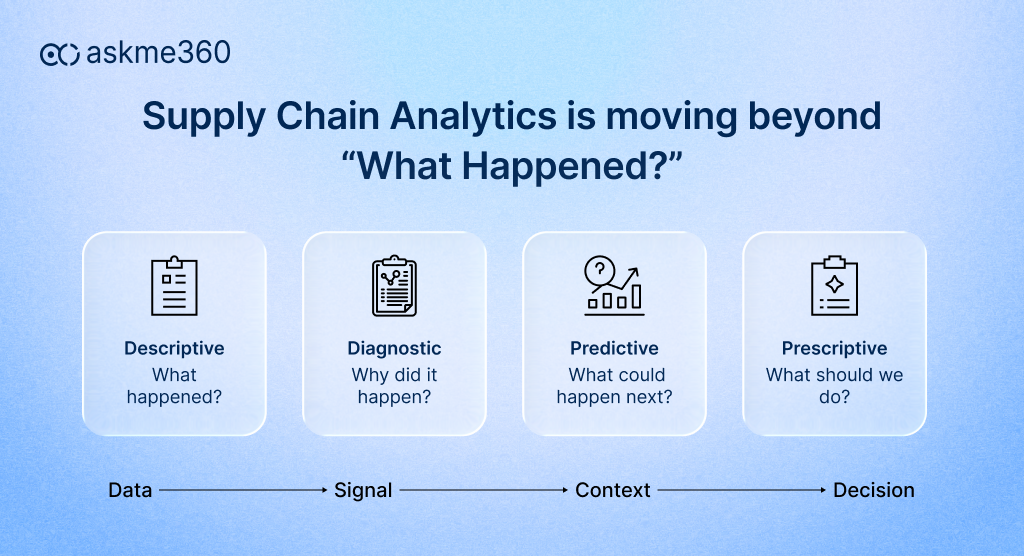
Descriptive Analytics - What happened?
Your ERP data should not leave your environment to get an intelligent answer. If an AI tool needs to send your financial records to an external server, a cloud you do not control, or a model provider whose data retention policy you never read, you have already lost the thread. Real financial data sovereignty means the data stays put. The intelligence comes to it, not the other way around.
Diagnostic Analytics - Why did it happen?
Nearly a third of all API vulnerabilities trace back to broken authentication and access control, and that statistic doesn’t stop applying just because the thing making the request is an AI model instead of a person. If your AI layer can see more than the human asking the question is permitted to see, you’ve built a backdoor around years of carefully designed ERP permissions. The fix is simple in concept: the AI inherits the same role-based access control your ERP already enforces. Nothing extra, nothing bypassed.
Predictive Analytics - What could happen next?
You need a timestamped, query able record of every AI interaction with financial data: who asked, what was returned, and when. Not because you assume bad intent, but because regulators eventually ask, and “we don’t have logs for that” is the answer that turns a minor incident into a major one. The SEC’s 2025 disclosure rules already require public companies to report material cybersecurity incidents within four business days. You can’t move that fast without logs that already exist.
Prescriptive Analytics - What should we consider doing?
Moving part of the requirement to Supplier B may reduce the risk to next month’s production plan.
Now analytics begins supporting action. This progression explains why AI is becoming increasingly important to operational decision-making.
Moving part of the requirement to Supplier B may reduce the risk to next month’s production plan.
Now analytics begins supporting action. This progression explains why AI is becoming increasingly important to operational decision-making.
It shortens the journey from:
Data → Signal → Context → Decision
What should AI automate, and what should stay human?
The strongest model for supply chain AI is not full autonomy everywhere. It is controlled autonomy based on business impact and risk. Some tasks carry relatively low risk. An AI agent may summarize supplier performance, generate a weekly inventory report, identify exceptions, or alert a procurement manager about an overdue PO. Other decisions carry much larger consequences.
Changing a strategic supplier, increasing a high-value purchase order, reallocating critical inventory, or changing a committed customer delivery date may still require human judgement and approval.
A practical Controlled Autonomy model is:
Inform → Recommend → Approve → Execute → Audit
As confidence grows, some workflows can move further toward automation. But governance should remain visible throughout.
Gartner predicts that by 2030, 50% of cross-functional supply chain management solutions will use intelligent agents to autonomously execute decisions. That makes clearly defined permissions, escalation rules, approvals, and audit trails increasingly important.
AI should not remove accountability from supply chain operations. It should improve the speed and quality of decisions within well-defined boundaries.
The future of Supply Chain Management is decision-centric
Supply chains will not become smarter simply because enterprises add AI to their technology stack. They become smarter when teams can recognize changing conditions earlier, understand their impact, and respond with greater confidence.
That is the real promise of AI in Supply Chain Management.
ERP systems helped enterprises digitize transactions. Supply chain analytics helped businesses measure performance. AI now creates an opportunity to connect those transactions, interpret operational context, anticipate exceptions, and bring intelligence closer to everyday decisions.
askme360 brings AI-powered intelligence to enterprise supply chains
askme360 is an AI-powered ERP agent designed to make enterprise data easier for business teams to understand and use. Instead of asking users to move through multiple ERP screens, depend on static dashboards, or wait for another custom report, askme360 allows them to begin with a natural business question.
Your ERP already contains a large part of your supply chain story. askme360 helps your teams ask better questions of that data, understand the answers faster, and move from insight to action with less friction.
Schedule a demo to know more!
Frequently Asked Questions
What are AI agents for ERP?
AI agents for ERP use artificial intelligence to interact with ERP data and, where permitted, workflows through business-friendly questions. They can help users analyze transactions, identify exceptions, generate reports, recommend actions, and automate approved tasks without requiring every question to become a custom report.
Can AI predict supply chain disruptions?
AI can help estimate potential disruptions by analyzing patterns across operational and external data. However, predictions are probabilistic rather than certain. Businesses should combine AI insights with good-quality data, defined thresholds, business rules, and human judgement.
How can AI improve order management insights?
AI can connect order data with inventory, warehouse, supplier, production, and logistics information to provide a more complete view of fulfilment. Instead of simply showing that an order is delayed, AI can help explain the cause, identify which orders need immediate attention, and support faster operational decision-making.