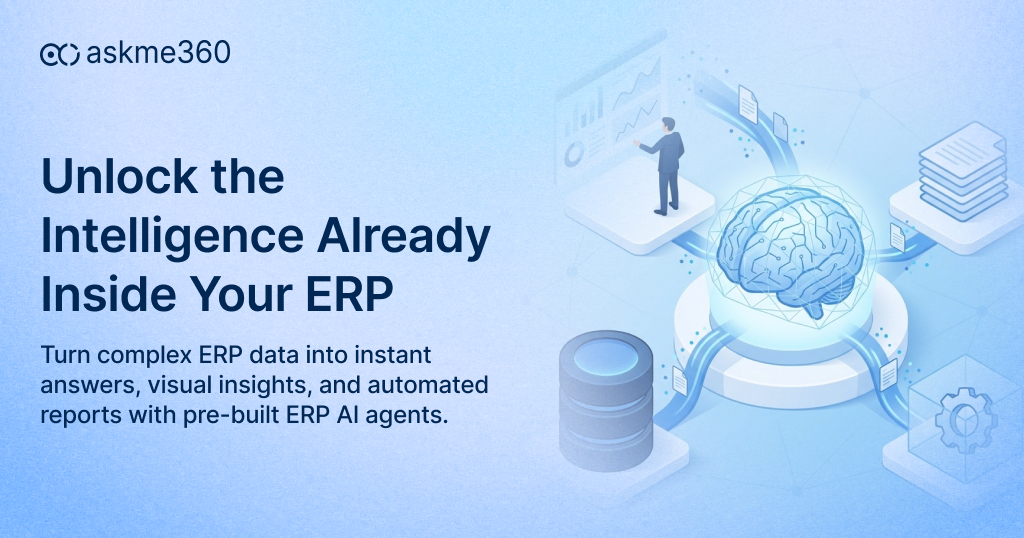
Your ERP already holds the answers your business needs. It knows which vendor is delaying production. It knows which customer is slowing cash flow. It knows where inventory is stuck, which invoices are overdue, and which department is spending beyond plan.
Still, in many enterprises, that answer takes days to reach the right person. Here, pre-built AI agents for ERP change the operating model. The signal is clear. The next phase of enterprise AI is not just about copilots or dashboards. It is about Enterprise AI agents that can understand, analyze, explain, and support decisions inside the systems your business already trusts.
Let us know how the pre-built AI agents for ERP systems work for your existing systems.
What are AI Agents for ERP Systems?
AI agents for ERP systems are intelligent assistants that connect with ERP data and help users ask questions, generate reports, view dashboards, and get business insights in natural language.
They do not replace your ERP, work with the systems your enterprise already runs, with an understanding of business questions, ERP data, role-based access, reports, dashboards, and workflows. More importantly, they allow your teams to ask questions in simple language and get real-time answers.
McKinsey’s 2025 State of AI report says 88% of organizations now use AI in at least one business function. The same report highlights that many companies are already experimenting with AI agents, but only about one-third have started scaling AI across the enterprise.
You ask a question. The agent understands the question. It connects with ERP data. It applies business context. Then it returns a clear answer, chart, report, or dashboard. This is the value of Conversational AI for ERP. It turns ERP data access from a technical process into a business conversation.
Why do enterprises need pre-built ERP AI Agents?
Enterprises need pre-built ERP AI agents because traditional reporting is slow, manual, and highly dependent on IT, analysts, and static dashboards. ERP systems run the digital core of your business. They support finance, procurement, supply chain, HR, inventory, projects, manufacturing, and compliance.
However, ERP reporting often remains slow. The issue is not the absence of data, but access. Business data sits behind tables, screens, approval flows, legacy reports, custom logic, and technical dependencies. So, every new question becomes a reporting request.
The usual process looks familiar:
- Business user asks for insight.
- Analyst checks the requirement.
- IT or BI team extracts the data.
- Report is prepared.
- Numbers are reviewed.
- Final version is shared.
- Business team takes action.
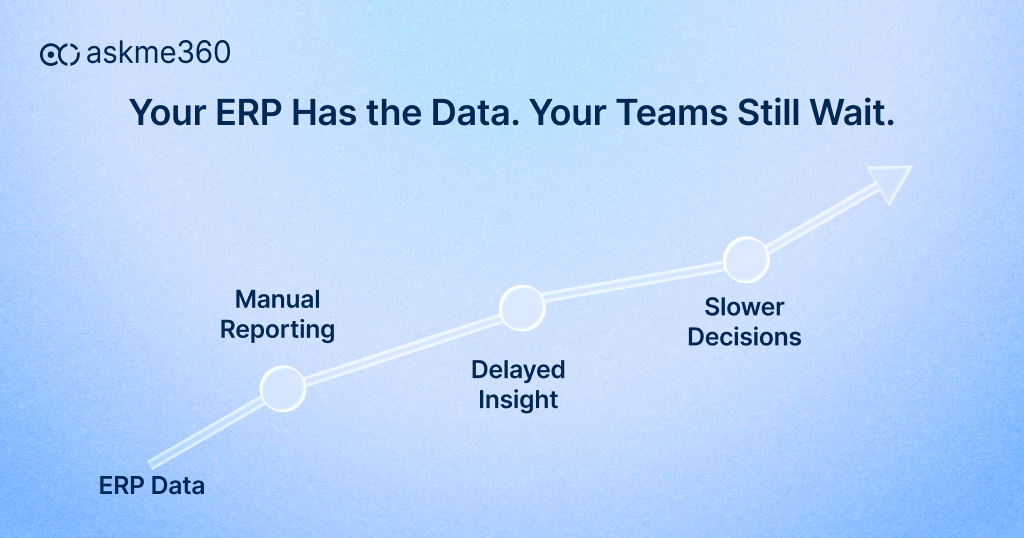
This can take days. That delay now carries a real business cost. Markets move faster. Suppliers change faster. Customer behavior shifts faster. If your reporting cycle takes a week, your business is managing today with last week’s visibility.
Pre-built ERP AI agents reduce this gap. They give users a faster way to access insights without disturbing the ERP system underneath.
How do pre-built AI agents for ERP improve real-time insights?
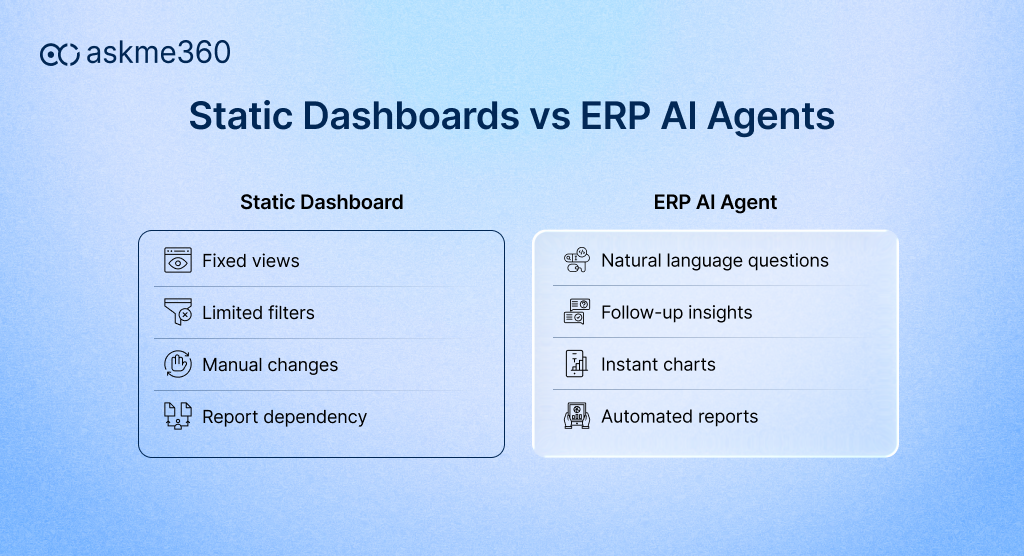
Pre-built AI agents improve real-time ERP insights by allowing business users to ask live questions, explore follow-ups, and get immediate answers from trusted ERP data. Traditional dashboards helped enterprises move away from spreadsheet overload. They gave leaders a structured view of business performance.
But dashboards have a limit. They show what someone has already built. If you need a new view, a new KPI, or a new cross-functional comparison, you often go back to the reporting team. As a result, the dashboard becomes useful, but not always flexible.
Real-time ERP insights need a different model. With ERP AI agents, your team can start with one question and move deeper. That is not static reporting, but guided business exploration. Gartner’s 2026 CDAO Agenda Survey states that AI-driven analytics offer the highest ROI for data and analytics leaders, improving business impact by up to 42%.
That matters because analytics sits close to money. It can improve margins, reduce delays, flag risk, and help leaders act before problems become expensive.
How does conversational AI for ERP change business reporting?
Conversational AI for ERP changes business reporting by allowing users to ask questions in plain language instead of waiting for custom reports, SQL queries, or manual data exports. Most leaders do not want more reports. They want better answers.
In traditional reporting, each question creates another dependency. With AI for ERP data access, each question becomes a conversation with your enterprise data.
That shift is powerful. Finance teams can check cash flow without waiting for month-end files. Procurement leaders can identify vendor delays before production gets affected. HR teams can use AI agents for HR to review workforce patterns without depending on static dashboards. Operations leaders can detect stock risk before the plant feels the impact.
This does not reduce the role of IT. It improves it. IT can focus on data governance, integration, access control, security, and architecture. Business teams get speed. The enterprise gets control. That is the right balance.
What makes pre-built enterprise AI agents different from generic AI tools?
Pre-built Enterprise AI agents are different because they are already designed around ERP domains, business functions, data structures, and common enterprise questions.
A generic AI tool is like a powerful engine without a vehicle. It can do many things. But your enterprise still needs to design the use case, build connectors, define prompts, map data, manage permissions, test outputs, and train users.
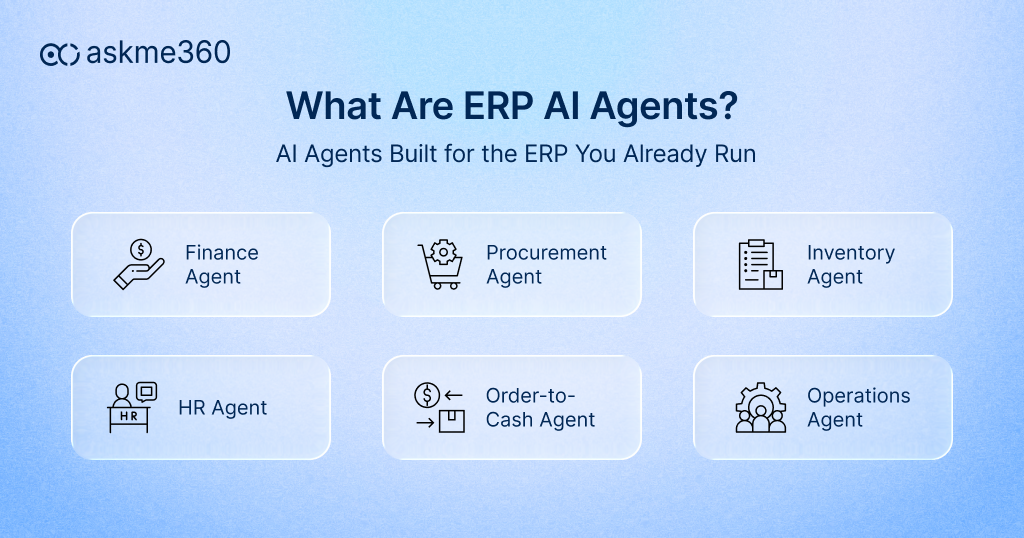
Pre-built AI agents for enterprise systems start closer to the business problem. They already understand standard ERP areas such as finance, procurement, inventory, order management, and HR. They know what purchase orders, invoices, vendors, receivables, stock levels, and employee records mean in a business context.
That makes adoption faster. AI in Finance can help teams analyse cash flow, expenses, revenue, receivables, payables, and budget variance. A Procure-to-Pay Agent can track vendor performance, delayed POs, purchase trends, approval bottlenecks, and outstanding liabilities.
Pre-built does not mean rigid. It means your enterprise starts faster, then extends based on your data, workflows, and business priorities.
How does ERP reporting automation help business leaders act faster?
ERP reporting automation helps business leaders act faster by reducing manual report preparation, automating recurring insights, and giving teams instant access to decision-ready data.
Manual reporting creates hidden friction. No one sees the delay clearly because it is spread across emails, follow-ups, extracts, reviews, corrections, and approvals. Yet, it drains time every week. A business head does not need to know how the report is built. They need to know what the numbers are saying.
ERP reporting automation helps by turning repeated reporting needs into repeatable, governed workflows. This brings rhythm to decision-making. Instead of asking, waiting, checking, and chasing, your teams receive the insights they need at the right time. They can also ask follow-up questions when something looks unusual.
That is how automation becomes more than efficiency. It becomes business discipline.
Why is secure AI for ERP critical for enterprise adoption?
Secure AI for ERP is critical because ERP systems contain sensitive business data, including financial records, supplier details, payroll information, contracts, customer orders, and compliance data.
ERP data cannot be treated casually. It includes vendor contracts, salary details, bank information, tax records, invoices, customer orders, pricing, and production plans. If AI connects to this data, security must be built into the architecture from day one.
IBM’s 2025 Cost of a Data Breach Report places the global average cost of a data breach at USD 4.44 million. That number should make every CIO, CFO, and business leader pause.
A secure ERP AI strategy needs four controls.
- Role-based access – Users should only see data they are authorized to view.
- Record-level security – Sensitive information must remain protected at the transaction level.
- Audit logging – Every query, access, and output should be traceable.
- Data governance – The enterprise must control where data stays, how it moves, and who can use it.
Gartner also predicts that through 2026, organizations will abandon 60% of AI projects that are not supported by AI-ready data. So, security is not separate from AI success. It is part of the foundation.
How should ERP integration with AI work in a real enterprise?
ERP integration with AI should connect securely with existing systems, respect user permissions, read business context, and deliver insights without disrupting core ERP operations.
A good AI layer should not force your enterprise to replace what already works. Your ERP may be Oracle EBS, PeopleSoft, SAP, Workday, or a custom enterprise database. You may also have data warehouses, spreadsheets, reports, files, and external applications around it.
That is normal. Large enterprises are rarely clean. They are layered. They are customized. They carry years of workflows, approvals, data rules, and business exceptions. So, ERP integration with AI must work with this reality.
The right approach is simple:
- Connect with existing ERP systems.
- Understand the data structure.
- Respect role-based access.
- Apply business context.
- Return answers in plain language.
- Support dashboards, reports, and exports.
- Keep governance intact.
This approach turns ERP from a system of record into a system of intelligence. The ERP continues to run transactions. The AI agent helps your people understand what those transactions mean.
Why should your enterprise adopt pre-built AI agents for ERP?
Your enterprise should adopt pre-built AI agents for ERP because they help teams access trusted ERP data faster, automate reporting, reduce dependency on manual analysis, and make better decisions in real time.
Your ERP does not need replacement. It needs a smarter access layer. Pre-built AI agents give your ERP a business-facing voice. They help your teams ask direct questions, get instant answers, create dashboards, automate reports, and move faster without losing governance.
In simple terms, ERP AI agents help your enterprise stop waiting for reports and start acting on intelligence.
How does askme360 help enterprises use secure AI for ERP?
HIPL and askme360 help enterprises use secure AI for ERP by bringing conversational ERP data access, real-time insights, automated reporting, dashboards, and governed AI integration into existing enterprise systems.
We bring deep enterprise technology experience across Oracle, cloud, data, integration, managed services, and AI-led business platforms. With askme360, HIPL extends that experience into a focused AI layer for enterprise ERP and business data.
askme360 is designed for businesses that want instant, secure, conversational access to ERP insights without replacing their existing systems. It connects with enterprise platforms such as Oracle EBS, PeopleSoft, SAP, data warehouses, custom databases, and business files. This allows leaders to ask questions in natural language and receive precise answers, dashboards, summaries, and reports.
The platform is built around three clear priorities: answers, action, and assurance. It helps your business move from slow reporting to real-time intelligence. It reduces manual follow-ups through ERP reporting automation. It supports secure access through role-based controls, governance, and enterprise-grade architecture. Most importantly, it gives your ERP a simple business interface that your teams can actually use.
Frequently Asked Questions
Are AI agents for ERP secure?
Yes, AI agents for ERP can be secure when they are built with enterprise-grade controls. A secure ERP AI solution should include role-based access, record-level security, single sign-on, audit logging, and data governance. These controls ensure that users only access the data they are authorized to view.
How does ERP reporting automation work with AI agents?
ERP reporting automation works by allowing users to schedule reports, generate recurring insights, and share dashboards or summaries automatically.
For example, a business can automate weekly vendor delay reports, monthly cash flow summaries, inventory shortage alerts, outstanding PO reports, and department-wise cost variance dashboards.
Do users need technical skills to use AI agents for ERP?
No, users do not need technical skills to use AI agents for ERP. The main advantage of Conversational AI for ERP is that business users can ask questions in simple language. They do not need SQL knowledge, BI development skills, or deep ERP technical expertise.
Why should enterprises choose pre-built AI agents instead of building AI from scratch?
Enterprises should choose pre-built AI agents because they reduce implementation time and start closer to business value.
A custom AI project often requires use case design, connector development, data mapping, prompt testing, security setup, and user training. Pre-built ERP AI agents already understand common business functions and standard ERP questions, so enterprises can move faster.