There is a familiar scene playing out in boardrooms and operations centres across every major industry right now. A sales director needs last quarter’s revenue breakdown by region, urgently, before a 9 AM leadership call. She submits a data request to IT. IT is already managing a backlog of 47 open tickets. Three days later, the report arrives. The leadership call happened on Tuesday. It is now Friday.
This is not a technology failure. It is an architecture failure. And if your business runs on SAP, you know this bottleneck intimately.
SAP powers over 77% of the world’s transaction revenue, according to SAP SE’s own figures. Yet despite sitting on one of the most data-rich enterprise platforms ever built, most organisations extract a fraction of the intelligence SAP holds. The data is there. The access is not.
That gap, between data availability and data usability, is precisely where AI for SAP is rewriting the rules.
Why SAP data access has been a business problem
The challenge with SAP data access is not that SAP is poorly designed. It is that SAP was built for transactional excellence, not conversational intelligence. Pulling meaningful insights has historically required:
- SAP Basis knowledge to navigate system architecture
- ABAP expertise to write and modify reports
- BW/BI consultants to manage data models and extracts
- Weeks of lead time for anything beyond a standard pre-built report
The result? A hard dependency on IT for every data question a business leader has, no matter how urgent, no matter how simple.
A 2023 survey by Dresner Advisory Services found that 74% of business users rely on IT or data teams to access the reports they need, even in organisations with established BI infrastructure. More damaging, Gartner estimates that poor data accessibility costs enterprises an average of $12.9 million per year in lost productivity and delayed decisions.
The bottleneck is structural. But the solution, today, is surprisingly accessible.
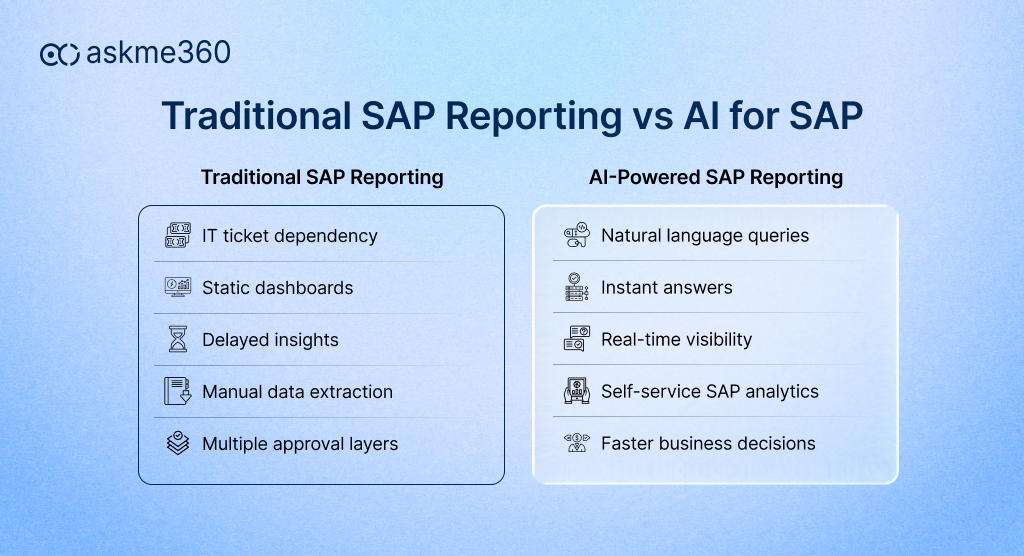
The Cost of IT-Dependent SAP Analytics Dashboards
Running IT-dependent SAP analytics is like owning a Formula 1 car but requiring committee approval every time you want to change gears. The engine is powerful. The bottleneck is entirely the process surrounding it.
Consider the typical SAP analytics dashboard workflow in a mid-to-large enterprise:
- Business user identifies a reporting need a new cut of data, a modified filter, a new KPI
- Request is raised via ITSM tool and enters the backlog queue
- Scoping and prioritisation happens against 40–60 other open tickets
- Development is assigned to an ABAP developer or BW consultant
- Build, test, and UAT cycle runs across multiple iterations
- Deployment finally reaches the user average lead time in two to six weeks
Meanwhile, the business question that triggered the request has evolved. The window of opportunity has closed. The decision was made on gut instinct instead of data.
IDC research indicates that organisations with self-service analytics capabilities make decisions up to five times faster than those relying on centralised IT-driven reporting. In supply chains, in financial planning, in customer operations, five times faster is the difference between leading your market and perpetually reacting to it.
How Enterprises Are Breaking Free From SAP Data Access Issues
Enterprises in 2026 are overcoming SAP data access bottlenecks by adopting embedded AI agents and semantic data layers that enable non-technical business users to query complex data, build applications, and automate workflows without constant IT support. By 2026, over 80% of operational work is being augmented by AI, allowing employees to focus on decision-making rather than manual data retrieval.
The most forward-thinking enterprises are not waiting for SAP to solve this natively. They are deploying AI-powered solutions that bridge the gap between SAP’s transactional depth and the decision-making speed their businesses demand.
The approach follows three core principles:
Natural Language as the Interface
Business users ask questions the way they think, in plain language, not transaction codes. AI interprets intent, not just syntax. A finance manager asking “what is our DSO trend over the last six months?” should not need to know which SAP table stores accounts receivable ageing data. The intelligence sits in the platform, not the user.
Real-Time SAP Reporting Without Data Replication
The most effective solutions query SAP directly, in real time, rather than maintaining a separate data copy that becomes stale the moment it is created. Real-time SAP reporting eliminates the lag that makes analytics dashboards feel like a rear-view mirror rather than a windshield.
Role-Based Access Without IT Mediation
Governance does not disappear in a self-service model, it gets embedded. AI-powered platforms enforce SAP authorisation objects intelligently, ensuring users see exactly what they are permitted to see, without an administrator manually managing every access request.
Core Technologies Driving Autonomous Access in 2026
The shift toward autonomous enterprise intelligence in 2026 is being powered by a new generation of SAP AI technologies designed to eliminate friction between data and decision-making. At the center of this transformation is SAP Business Data Cloud (BDC), which creates a unified and consistent enterprise data layer, allowing AI systems to understand the business context behind transactions rather than simply processing raw numbers.
Alongside this, Agentic AI agents are enabling a more proactive operating model by continuously scanning order pipelines, detecting anomalies in real time, and even recommending supplier rerouting or corrective actions independently.
Meanwhile, SAP Analytics Cloud (SAC) is evolving beyond traditional dashboards with capabilities like “Just Ask” natural language querying and generative AI-powered report creation, allowing business users to generate insights conversationally without depending on technical reporting teams. Together, these technologies are redefining enterprise SAP access from static reporting to intelligent, autonomous decision support.
The enterprises that execute the three principles and using the SAP technologies are not just saving IT hours. They are fundamentally changing who participates in data-driven decision making.
The Business Case for Self-Service SAP Analytics
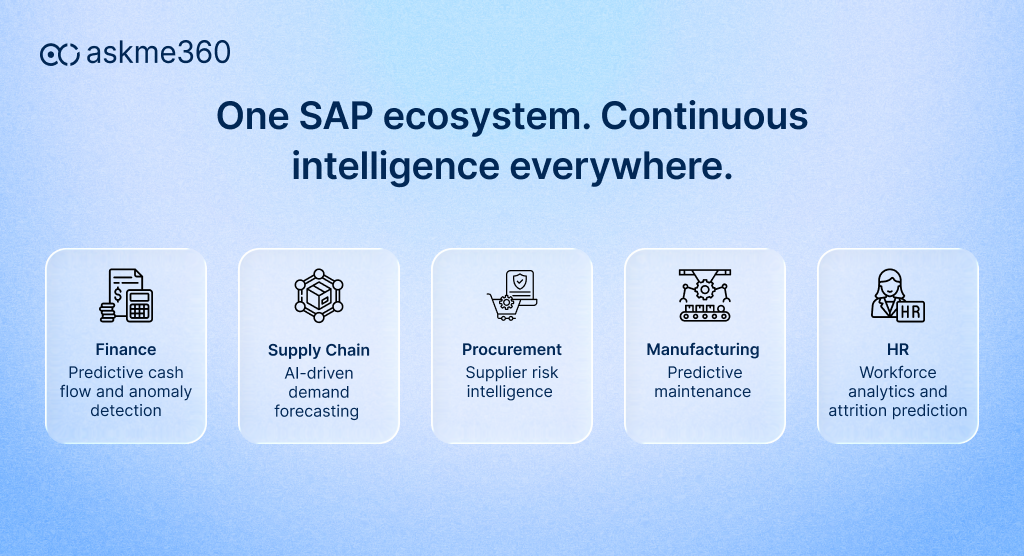
It is not about technology. It is about time-to-decision. It is about eliminating the 72-hour lag between a question and an answer in a world where market conditions shift in 72 minutes. The business case plays out across every function in your organisation:
- Finance – Month-end close accelerates when controllers self-serve reconciliation data rather than waiting three days for a report
- Procurement – Buyers identify maverick spend and overdue POs in real time, not retrospectively
- Supply Chain – Plant managers respond to inventory shortfalls the moment they appear, not after a ticket is resolved
- Sales – Revenue leaders walk into every pipeline review with data they pulled that morning, not last Tuesday
- HR – Workforce analytics become accessible to HR business partners without involving a single line of ABAP
Organisations that deploy AI for SAP report an average 30–40% reduction in IT reporting workload within the first six months, according to implementation data from leading enterprise AI vendors. More significantly, they report measurable improvement in decision cycle time, the period between a business question arising and a data-backed decision being made.
That compression of decision cycles is where the real ROI lives. Not in the tool itself, but in every faster, better-informed decision your business makes because of it.
A Practical Roadmap to Eliminating SAP Data Access Bottlenecks
If you are a CIO, a business head, or a department leader recognising your organisation in these patterns, the barrier to change has never been lower.
Here is how the most successful enterprises approach the transition:
- Phase 1 – Identify the highest-friction reporting bottleneck Pick one department where delayed SAP data has a visible, measurable cost. Finance, procurement, and supply chain are typically the fastest wins.
- Phase 2 – Deploy an AI layer over your existing SAP landscape No migration. No restructuring. The right platform connects to your SAP environment as-is and begins returning value within weeks, not months.
- Phase 3 – Enable self-service for a defined user group Start with ten to twenty power users. Let them ask questions, validate outputs, and build confidence in the platform before broader rollout.
- Phase 4 – Measure and expand Track IT ticket reduction, decision cycle time, and user adoption. Use those metrics to build the internal case for enterprise-wide deployment.
You do not need a multi-year transformation programme. You need an intelligent layer that makes what you already own dramatically more accessible to the people who need it most.
Moving Forward
SAP data access bottlenecks are not an inevitability. They are a design choice and one that an increasing number of enterprises are actively choosing to reverse. AI-powered SAP reporting, delivered through natural language interfaces and real-time query capabilities, is transforming how organisations interact with their most critical enterprise data.
The shift from IT-dependent SAP analytics to genuine self-service SAP analytics is not a distant future state. For the enterprises moving fastest, it is already the operational standard.
The data your business needs to make better decisions is already in SAP. AI is simply making it possible for the right people to ask for it, get it instantly, and act on it without waiting for a ticket.
Powered by Intelligence - askme360
askme360 is HIPL’s flagship AI-powered self-service SAP analytics platform, and it is precisely engineered to eliminate the bottleneck between your SAP data and the people who need it most. askme360 does not sit alongside your SAP environment. It connects directly into it, querying live SAP data in real time, with no replication, no staging layer, and no IT intermediary between your business users and the answers they need.
Where most BI tools demand that users adapt to the platform, askme360 adapts to the user. Business teams across finance, procurement, supply chain, sales, and HR ask questions in plain, everyday language, and receive structured, role-appropriate, real-time answers drawn directly from SAP.
Explore what askme360 can do for your organisation. Connect with the HIPL team to schedule a live demonstration tailored to your industry, your SAP environment, and your most pressing data access challenges.
Frequently Asked Questions
How can finance teams get real-time SAP insights without waiting for reports?
Finance teams must not rely entirely on static SAP reporting cycles or wait for IT teams to generate reports. With modern AI for SAP platforms, organizations can enable real-time SAP reporting through conversational analytics and AI-driven insights. Instead of navigating multiple SAP analytics dashboards or manually extracting financial data, finance leaders can simply ask questions in natural language and receive instant visibility into cash flow, liabilities, vendor payments, and revenue trends. This shift toward AI-powered SAP reporting helps enterprises reduce reporting delays, improve financial agility, and make faster decisions without operational bottlenecks.
How is AI for SAP different from traditional SAP analytics dashboards?
Traditional SAP analytics dashboards are designed primarily for data visualization and predefined reporting. While they provide visibility into historical business performance, they often require manual setup, technical expertise, and continuous dashboard maintenance. AI for SAP introduces a more intelligent and dynamic approach by enabling natural language interaction, predictive insights, anomaly detection, and context-aware recommendations. Instead of simply displaying data, AI-powered SAP reporting systems help enterprises understand why trends are happening and what actions should be taken next, making decision-making faster and more proactive.
Can non-technical users access SAP data without IT dependency?
Yes. One of the biggest advantages of self-service SAP analytics is that it removes the traditional dependency on IT and reporting teams for everyday business insights. Modern AI for SAP platforms allow non-technical users to interact directly with enterprise data using conversational queries instead of transaction codes, SQL, or complex reporting tools. This enables finance, procurement, HR, and operations teams to access real-time insights independently while still maintaining enterprise-grade governance and security. As a result, organizations can eliminate many common SAP data access issues and accelerate enterprise decision-making.
Is there a faster alternative to traditional SAP dashboards and BI reports?
AI-powered SAP reporting platforms are emerging as a much faster alternative to traditional SAP dashboards and BI reporting environments. Conventional reporting workflows often involve multiple layers of data extraction, dashboard configuration, and analyst intervention, which slows down insight delivery. In contrast, AI-driven systems provide real-time SAP reporting through conversational interfaces that instantly retrieve, analyze, and summarize enterprise data. This allows business leaders to move beyond static dashboards and access operational intelligence on demand, significantly improving responsiveness and execution speed.
How can enterprises reduce delays in SAP reporting and analytics?
Enterprises can reduce delays in SAP reporting and analytics by shifting from manual, IT-dependent reporting models to AI-driven and self-service SAP analytics environments. By implementing AI for SAP solutions, organizations can automate report generation, simplify SAP data access, and provide real-time visibility across finance, procurement, HR, and supply chain operations. Strengthening data governance, enabling conversational AI interfaces, and integrating AI-powered SAP reporting capabilities also help eliminate reporting bottlenecks and reduce dependency on technical teams. This enables faster access to trusted insights and supports more agile, data-driven business operations.