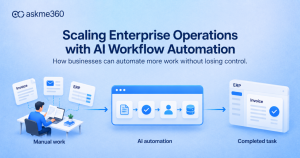
Not every decision needs a meeting. But not every decision should be left to a machine either. That difference is becoming really important as businesses introduce AI into everyday operations. From analyzing financial information and processing invoices to reviewing supplier records and managing internal workflows, AI is taking on tasks that once required an actual manual effort. The next challenge for enterprises is not simply deciding what AI can do but deciding how much responsibility it should have. This is where human AI collaboration becomes potent to enterprise strategy.
The goal is not to keep people involved in every step from beginning to end. It is to develop a practical working relationship in which AI handles appropriate tasks, people contribute judgment where it matters, and accountability remains clear throughout. For business leaders, this calls for a rather planned approach to AI decision-making, this is knowing when to delegate and when to intervene.
Why is Human AI Collaboration becoming important for enterprises?
Enterprise AI adoption has moved ahead of isolated experiments. Businesses are now exploring AI not only for content generation and getting information but also for activities involving multiple steps, connected systems, and operational decisions.
Deloitte’s 2026 research says that while 75% of surveyed leaders believe human collaboration with AI agents creates more value than AI-powered automation alone, only 5% said their business processes were highly prepared for AI agents. This gap shows that businesses may have the technology to automate tasks, but they still need to see how those tasks fit into existing processes, who oversees the outcomes, and when human judgment is necessary. That opportunity might lie in AI augmentation, using AI to extend human capabilities rather than treating automation and human involvement as competing approaches.
How does human AI collaboration work with human-in-the-loop AI?
The term human in the loop AI describes an approach in which people participate in specific stages of an AI-supported process. Depending on the task, a person may review an output, approve an action, resolve an exception, or make the final decision. However, human involvement does not have to look the same across every workflow.
Let’s look at these three simple processes –
- Human-led – People make the decisions and use AI for research, suggestions, analysis, or assistance.
- AI-assisted execution- AI completes defined tasks, while people review outputs or approve consequential actions.
- AI-led execution with human oversight- AI handles routine, permitted steps independently and refers exceptions or decisions outside its authority to the appropriate person.
These models are not a simple progression towards removing human involvement. The right arrangement depends on the task, its potential impact, and the reliability of the system.
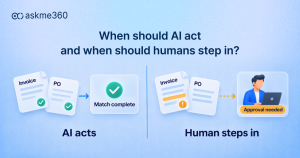
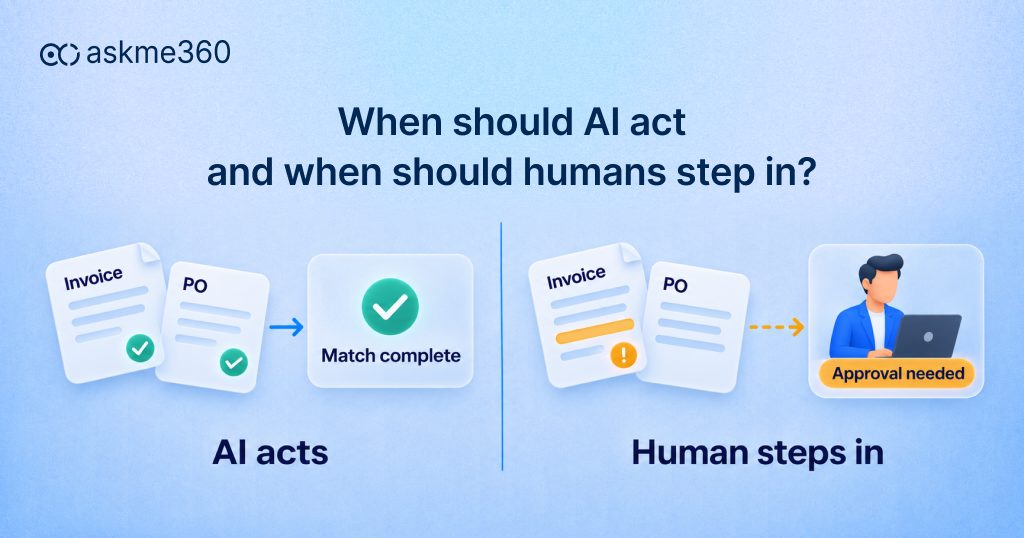
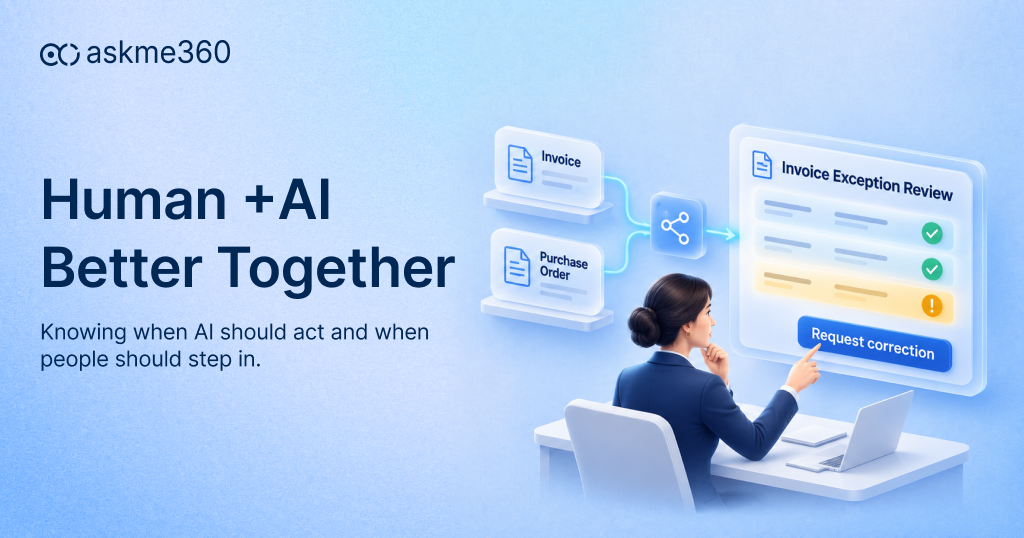
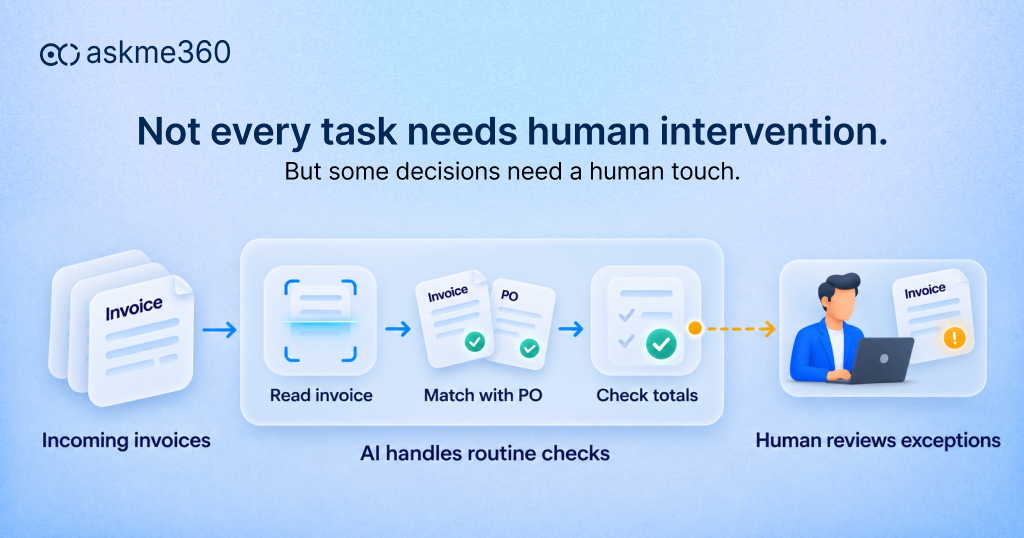
For example, an AI system getting information from an invoice may be able to process a clearly readable document and validate its details against a purchase order. However, if the amounts do not match or supporting information is missing, the workflow may need to pause for review and let the right person take corrective action.
When should autonomous AI agents act independently and when should humans step in?
This is one of the most important decisions enterprises need to make before deploying autonomous AI agents in business workflows. A good starting point would be to differentiate between routine tasks and decisions that carry greater uncertainty, financial impact, or organizational risk.
AI can generally handle defined tasks when-
- The task follows clear and documented rules.
- The required information is available and sufficiently reliable.
- The action falls within explicitly assigned permissions.
- The outcome can be checked against set conditions.
- Errors are limited in impact and can be corrected through a defined process.
Human intervention becomes important when-
- Information is incomplete or inconsistent.
- An action falls outside the approved policy.
- The decision involves some financial, legal, or reputational consequences.
- The system cannot establish sufficient confidence in the information or outcome.
Take supplier onboarding as an example. An AI workflow may collect documents, extract registration details, check required information, and identify missing records. But a potential compliance issue or conflicting supplier information may need a procurement or compliance professional to investigate before onboarding proceeds.
This case is quite relevant for vendor compliance management where a basic routine administrative step can have implications for procurement risk and regulatory obligations.
How can AI guardrails support human AI collaboration in business workflows?
Delegating work to AI without defining its boundaries is rather like assigning an employee a responsibility without explaining the approval process. The work may get done but that leaves the organization with very little assurance.
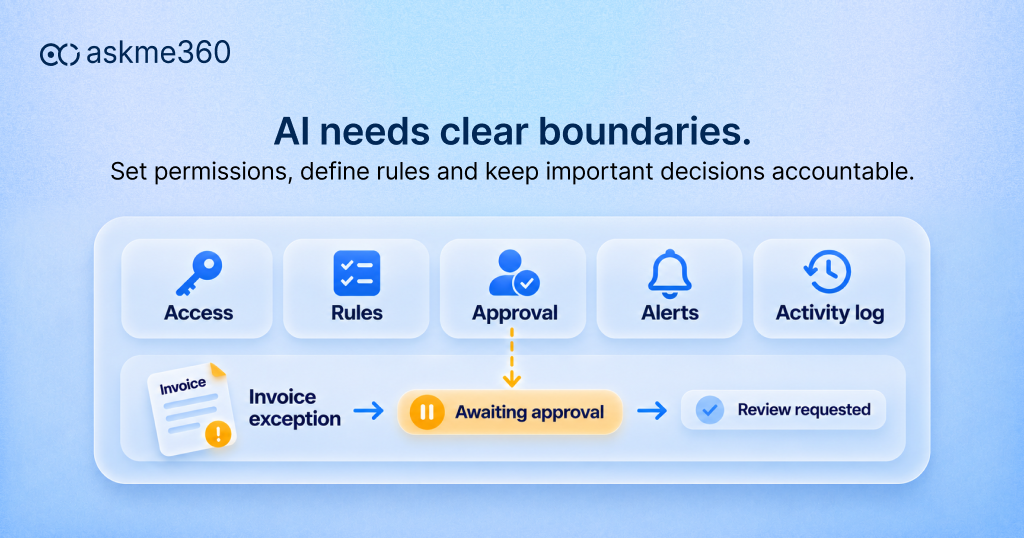
This is where AI guardrails become important. Guardrails are the rules, permissions, and constraints that define what an AI system can access, recommend, or execute. They help translate an organization’s expectations into real boundaries for AI-supported work.
Proper guardrails should include –
- Access and permissions
AI systems should only access the information and tools needed for their assigned tasks.
- Defined action boundaries
An AI agent should have an understanding on which actions it can perform independently, which require approval, and which are outside its permitted scope.
- Exception handling
When a workflow encounters missing information, conflicting records, or a policy exception, it should have a defined route for pausing, escalating, or requesting human review.
- Traceability
Organizations should be able to examine what information informed an action, what the system did, and whether a person intervened or approved the next step.
These measures also contribute to AI control. Rather than treating control as a restriction imposed on AI, enterprises should view it as an important part of designing trustworthy workflows.
How can approval workflows help businesses maintain human oversight of AI decisions?
Approval workflows help organizations decide where human judgment is needed and make that involvement a part of the process itself. For example, a finance workflow may allow an AI system to extract invoice information, validate fields, and prepare a transaction. But a mismatch, an unusual amount, or a transaction outside the defined approval conditions may require review by an authorized employee.
A good approval workflow should determine-
- Which actions can proceed automatically.
- Which conditions trigger a review.
- Who is authorized to approve or reject an action.
- What information the reviewer needs to decide.
- How the decision and subsequent action are recorded.
This is important when using AI agents for business processes. The goal is to make human involvement meaningful. If employees are asked to review every action, approval queues can become another operational bottleneck.
How can businesses maintain AI accountability while allowing AI agents to work autonomously?
Autonomy does not remove organizational responsibility. Even when an AI system performs a task independently, the business remains responsible for defining its permitted use, managing its risks, and knowing who is accountable for the outcome.
Businesses should build AI transparency into their operating practices so that stakeholders can understand how a system is being used, what actions it performs, and when human intervention happens.
The NIST AI Risk Management Framework also focuses on the importance of clearly defining human roles and responsibilities in AI systems, documenting oversight, and tracking policy exceptions and escalations. When it comes to enterprise AI security access management, data protection, traceability, and accountability need to remain connected throughout the AI lifecycle.
AI accountability is not about expecting AI to take responsibility. It is about ensuring that responsibility remains clearly assigned to the people and functions operating the system.
A successful human-AI operating model starts with the process, not the technology. This is important to keep in mind when organizations introduce AI agents for ERP environments, where workflows may interact with financial records, procurement information, employee data, and other important business systems.
The future is not AI instead of people. It is better work between them.
As AI becomes more involved in enterprise operations, the question will not simply be how much work organisations can automate. It will be how effectively they distribute responsibilities between people and intelligent systems.
Repetitive tasks can move faster. Information can be processed at scale. Exceptions can be identified earlier. And employees can spend less time coordinating repetitive work and more time applying their expertise. The most effective approach to Human AI Collaboration is therefore not to keep a person involved in every action or remove people from every process. It is to know where each brings the most value and build the workflow accordingly.
Bringing human judgment and AI execution together with askme360
The next phase of enterprise AI is not simply about making more tasks autonomous. It is about connecting information, execution, and oversight in a way that supports business outcomes without overlooking the controls that matter. This is where askme360 brings its expertise.
askme360 brings together enterprise intelligence, workflow execution, and assurance through its answers, action, and assurance layers. askme360 gets connected to an organization’s existing ERP system or database and answers all business queries supporting different departments.
The action Layer supports defined business workflows, helping reduce manual effort across activities such as invoice and expense processing, bank reconciliation, recruitment workflows, email-driven tasks, and many more.
The assurance Layer focuses on validating business activity against relevant policies and controls. Together, these layers address two important requirements of enterprise AI, enabling defined actions and keeping business controls in view.
Frequently Asked Questions
Can AI make decisions without human approval?
Yes. AI can independently handle routine tasks and decisions that follow clear rules. However, decisions involving financial risks, policy exceptions, or uncertain information may still require human approval.
Does human oversight slow down AI automation?
Not necessarily. When approval requirements are clearly defined, AI can complete routine tasks without delays and involve people only when their judgment is needed.
How can human-AI collaboration improve employee productivity?
AI can take care of repetitive work such as data entry, information gathering, and document checks. This allows employees to spend more time on solving problems, planning, and taking important business decisions.
What should businesses do when an AI agent makes a mistake?
Businesses should have a clear process to identify, report, and correct errors. They should also review what caused the mistake and make necessary changes to the system, permissions, or workflow.
Can human-AI collaboration work across different business departments?
Yes. It can support functions such as finance, procurement, HR, sales, and operations. The level of AI involvement will depend on the tasks, business rules, and decisions involved.