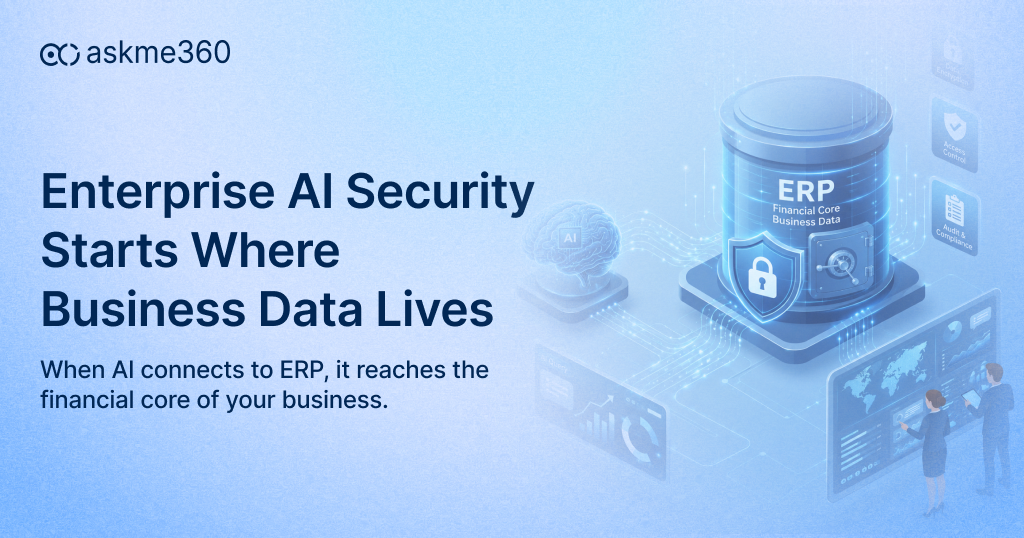
In September 2025, a ransomware group linked to Clop did not use the usual phishing playbook. They did not send a malware-loaded email. They did not trick employees into clicking a suspicious link. Instead, they went straight after a zero-day vulnerability in Oracle E-Business Suite, the ERP system that runs finance operations for enterprises across the world. Once inside, they reportedly used compromised third-party accounts to email executives directly. This is the part many boardroom conversations about AI still overlook. The deeper exposure sits inside the ERP itself, where AI platforms, integrations, and automated agents are now getting regular access to highly sensitive financial data. Therefore, Enterprise AI Security is a priority for organizations using AI agents, copilots, and integrations across ERP systems.
Most leaders are still discussing chatbot policies, employee prompts, and public AI tools. Whether we should use AI or not, is an ancient discussion now. The real question is, who, or what, can touch your ERP data, and can you prove it?
What is enterprise AI security for ERP?
Enterprise AI security is the set of controls that govern how AI models, copilots, agents, and integrations interact with the systems running your business, especially the ones holding financial records.
For an ERP environment specifically, that means three things have to be true at all times:
- The AI never sees data the requesting user couldn’t already see on their own.
- Every query, every output, and every data touchpoint gets logged somewhere you can actually audit.
- Your financial data stays inside systems you control, not inside a vendor’s training pipeline or a third-party cloud you’ve never reviewed.
If you miss any one of those, then you don’t have ERP data security. You have a faster way to leak financial data. Financial services breaches now cost an average of $5.56 million, a full 25% above the global average across industries, according to IBM’s 2025 Cost of a Data Breach Report. And in Q1 2026 alone, finance-sector incidents jumped 76% compared to the same period a year earlier, according to Black Kite’s 2026 Financial Services Cybersecurity Report.
In India, the average breach cost touched INR 220 million in 2025. These are not abstract numbers. They are reminders that poor data control carries real business cost.
Why have ERP systems become the preferred target?
Your ERP holds some of your most important data, including payroll, supplier contracts, banking details, revenue records, tax data, invoices, and vendor payments. If attackers get into your ERP, they are not just stealing a few files. They are getting access to the financial engine of your business. This is the bigger pattern security teams are seeing in 2026.
Attackers are not always trying to break through the strongest front door. Instead, they look for a weaker side door. That side door could be a vendor, a plugin, a third-party tool, or an AI integration connected to your ERP.
The risk is growing fast. Black Kite’s research found that 76 out of 140 core finance vendors now have at least one critical vulnerability that is already being actively exploited. A year earlier, that number was only 15. This shows how much pressure the finance technology supply chain is under.
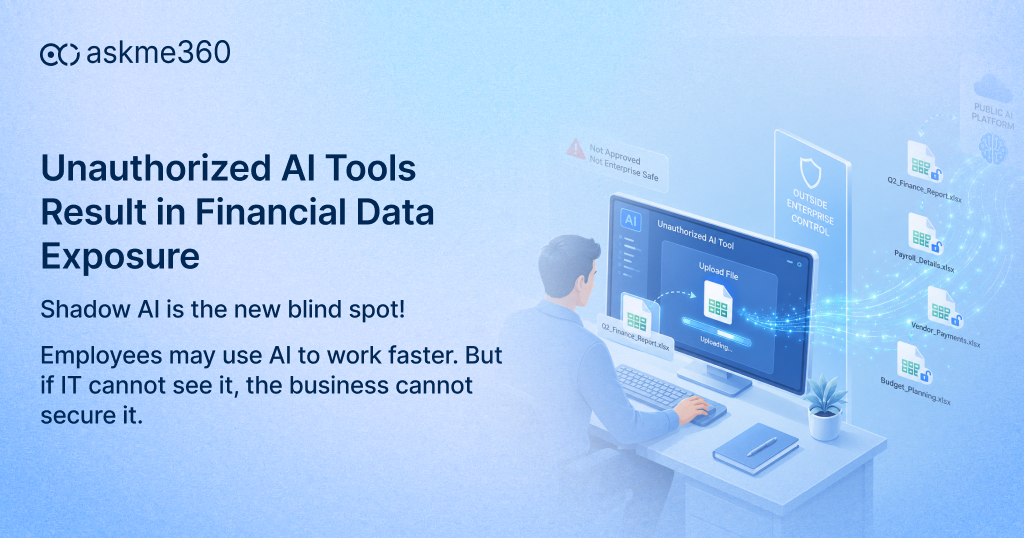
Now add AI to this environment, and the risk becomes even bigger. Many employees use AI tools without IT knowing about it. This is called shadow AI. According to IBM, shadow AI played a role in 20% of breaches last year and added an average of $670,000 to the final cost of a breach.
The bigger concern is that 97% of AI-related breaches happened in organizations that had no AI access controls in place. That means the problem is not only AI. The real problem is AI without control.
Why does Financial ERP data need protection?
Financial ERP data needs protection because it is valuable. For an attacker, it can reveal payment cycles, vendor relationships, bank details, salary structures, pricing models, and approval weaknesses. For an insider, it can open the door to invoice fraud, payment manipulation, or unauthorized reporting. For a competitor, it can expose business strategy. That is why financial data protection must go beyond basic passwords.
Your ERP may already have strong controls. But when AI is introduced, those controls must extend into the AI layer too. Here is the simple rule:
If a user cannot access data inside the ERP, they should not access it through AI.
This sounds basic. Yet it is one of the biggest risks in enterprise AI adoption. AI must never become a shortcut around ERP permissions.
For example:
- Regional manager should not see company-wide payroll data.
- Procurement user should not access confidential finance strategy.
- Junior employee should not view board-level cash flow reports.
- Business user should not export restricted financial records without traceability.
This is where Financial ERP data security, role-based access control, and audit logging in AI become business-critical. Protecting financial ERP data in the AI era requires a multi-layered approach that applies your existing financial ERP data security clearances to dynamic AI interactions. Because AI can inadvertently expose, manipulate, or synthesize data, ERP data security must be embedded directly into the application layer, restricting what AI models can access, process, and generate.
How does AI pose a security threat for ERP?
Traditional ERP data security was built around users, roles, workflows, passwords, and approvals. AI changes the surface area. Now, instead of clicking through menus, users can simply ask questions. That creates convenience. It also creates new risks.
1. Prompt Injection
Prompt injection happens when a user or hidden instruction tries to manipulate the AI. For example, someone may ask the AI to ignore access rules, reveal restricted records, or generate unauthorized data. In some cases, the malicious instruction can even sit inside a document, email, webpage, or dataset that the AI reads. This is why AI systems must validate prompts, enforce permissions, and restrict what the model can access.
2. Sensitive Data Leakage
AI can accidentally expose information in its response if the system does not control data boundaries. A simple question such as “show salary cost by department” may return sensitive HR-finance data if role checks are weak. For finance teams, this is a serious issue. Financial data leakage can damage compliance, vendor trust, employee confidence, and market reputation.
3. Shadow AI
Shadow AI happens when employees use unauthorized AI tools for work. This often starts innocently. Someone wants to summarize a financial report, clean up an Excel file, or draft a management note. So, they upload data into a public AI tool. The result? IT has no visibility. Security has no control. The business has no guarantee where the data went. IBM found that high levels of shadow AI added USD 670,000 to average breach costs. That is the price of convenience without governance.
4. Excessive Agency
Agentic AI can do more than answer. It can act. It can generate reports, send emails, trigger workflows, call APIs, create summaries, and automate routine tasks.
That is useful. But it must be controlled.
- The AI agent can prepare a payment report, but who approves the export?
- If it can send reports by email, who controls the distribution list?
- Since it can query ERP data, which tables can it access?
- If it can recommend action, who validates the recommendation?
In enterprise AI, autonomy without guardrails is not innovation. It is exposure.
5. Hallucinated Financial Insight
AI can sound confident even when it is wrong. In general content, that may be inconvenient. In finance, it can be costly.
A wrong cash flow summary can affect working capital planning. A wrong vendor risk view can affect procurement decisions. A wrong receivables analysis can distort collection priorities.
So, secure AI for ERP must be grounded in trusted ERP data. It must not guess when the answer needs evidence.
How do you secure AI for ERP?
Get these right, and you have closed most of the gap that attackers, and auditors, care about.
1. Financial Data Sovereignty
Your ERP data should not leave your environment to get an intelligent answer. If an AI tool needs to send your financial records to an external server, a cloud you do not control, or a model provider whose data retention policy you never read, you have already lost the thread. Real financial data sovereignty means the data stays put. The intelligence comes to it, not the other way around.
2. Role-Based Access Control, Enforced at the AI Layer Too
Nearly a third of all API vulnerabilities trace back to broken authentication and access control, and that statistic doesn’t stop applying just because the thing making the request is an AI model instead of a person. If your AI layer can see more than the human asking the question is permitted to see, you’ve built a backdoor around years of carefully designed ERP permissions. The fix is simple in concept: the AI inherits the same role-based access control your ERP already enforces. Nothing extra, nothing bypassed.
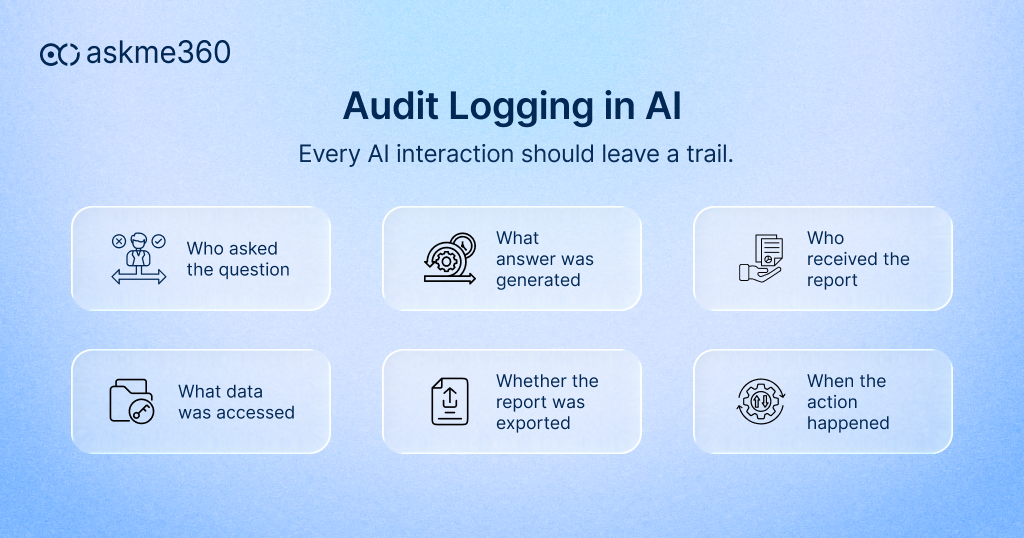
3. Audit Logging in AI, by Default
You need a timestamped, query able record of every AI interaction with financial data: who asked, what was returned, and when. Not because you assume bad intent, but because regulators eventually ask, and “we don’t have logs for that” is the answer that turns a minor incident into a major one. The SEC’s 2025 disclosure rules already require public companies to report material cybersecurity incidents within four business days. You can’t move that fast without logs that already exist.
Where do most companies fail in Enterprise AI Governance?
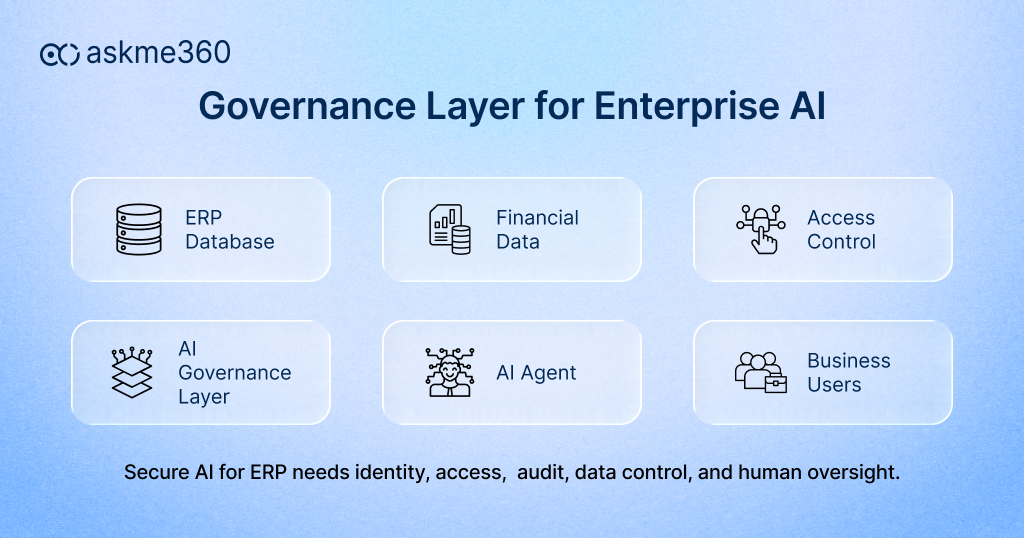
63% of organizations still have no AI governance policy at all, and only 24% have a team specifically accountable for AI security. That means most businesses deploying AI today have nobody whose job it is to notice when something goes wrong.
Governance is a working process with three habits behind it:
- Approval before adoption. Organizations with strict AI approval policies see materially lower breach exposure. It’s a five-minute review process that prevents months of cleanup.
- Regular, honest audits. Internal teams currently catch only 57% of shadow AI incidents on their own. The rest surface through outside disclosure, customer complaints, or regulators, which is the most expensive way to find out.
- Insurance-grade documentation. Over 65% of new cyber insurance policies now carry specific AI risk exclusion clauses, per Munich Re’s 2025 Global Cyber Risk and Insurance Survey. If you can’t document your AI governance, you may discover your policy simply doesn’t cover the incident you’re dealing with.
What the Future Holds
The businesses pulling ahead in 2026 are the ones who stopped treating AI adoption and financial data protection as two separate jobs. Role-based access, audit logging, and data sovereignty aren’t friction that slows AI down. They are what makes AI safe enough to actually trust with the system your entire business runs on.
Your ERP holds the truth about how your company makes and moves money. The question isn’t whether AI gets access to that truth. It already has, in most companies, whether anyone approved it or not. The question is whether you can prove, today, exactly who and what has touched it.
Enterprise AI protection from HIPL
For over 3 decades, Heuristics Informatics Pvt. Ltd. (HIPL) has built and secured the ERP backbones that finance teams actually run on, Oracle, PeopleSoft, SAP, and custom systems, for organizations where a security shortcut simply isn’t an option. That history is the reason askme360, HIPL’s AI-powered enterprise agent, was designed to protect your data from escaping your ecosystem.
askme360 sits inside your existing ERP and database environment, answers questions in plain language, and never duplicates, extracts, or routes your financial data anywhere outside your own infrastructure. Every query runs through the same role-based access and permissions you’ve already set up, with a full audit trail behind it. Nothing new to govern, nothing new to expose, just the ERP intelligence your team needs, secured the way financial data actually demands.
Frequently Asked Questions
What is enterprise AI security, and how is it different from regular cybersecurity?
Enterprise AI security focuses specifically on how AI models, agents, and integrations access, process, and act on company data, with particular attention to data leaving controlled environments, model-specific vulnerabilities like prompt injection, and access governance for non-human identities. Regular cybersecurity covers networks, endpoints, and applications broadly; AI security is a more specialized layer on top.
Why is financial ERP data a higher-value target than other business data?
ERP systems centralize payroll, banking details, vendor contracts, and revenue data in one place. A single ERP compromise, like the 2025 Oracle E-Business Suite exploit, can expose the financial operating logic of an entire business at once, rather than one isolated dataset.
Does connecting AI to an ERP automatically create new security risk?
Not if the AI inherits existing role-based access controls and never operates outside them. The risk comes from AI tools that bypass existing permissions, duplicate data into external systems, or operate without audit logging, not from AI itself.
What is shadow AI, and why does it matter for financial data protection?
Shadow AI refers to AI tools employees use without formal IT approval or oversight. It was a factor in 20% of breaches in 2025 and added an average of $670,000 to breach costs, largely because these tools operate completely outside existing governance and access controls.