There is a quiet frustration growing in finance leadership, and most CFOs know exactly what it feels like. You open your ERP dashboard. The numbers are there. The charts look clean. But the moment something shifts, there is a budget variance, a cash shortfall, a receivables spike, and you are back to sending emails, waiting for analyst pulls, chasing down data exports, and trying to piece together an answer before the board meeting at 10 AM.
Dashboards were supposed to solve this. The promise was visibility. The reality is that visibility without the ability to ask follow-up questions is like reading a weather report without being able to look outside. You see the forecast. But you still cannot act with confidence.
Consequently, CFOs are moving toward conversational analytics. It gives finance leaders a faster way to work with ERP data. Instead of clicking through multiple dashboards or waiting for custom reports, they can ask questions in natural business language and get direct, ERP-grounded answers.
Let us explore why AI vs BI dashboards for ERP reporting is gaining importance in discussions across enterprises.
What are BI Dashboards in ERP reporting?
BI dashboards in ERP reporting are visual tools that convert ERP data into charts, KPIs, tables, and reports. They help finance and business teams monitor performance across key areas such as revenue, cost, cash flow, budgets, inventory, procurement, and operations.
For years, BI dashboards for finance have played an important role in enterprise decision-making. They give CFOs a clean view of what is happening across the business.
CFOs use dashboards to track:
- Cash flow position
- Budget vs actual performance
- Revenue movement
- Outstanding receivables
- Pending payables
- Cost centre performance
- Vendor spend
- Inventory value
- Working capital trends
These dashboards are useful. They bring structure to complex ERP data. They also reduce the need to open multiple ERP screens for basic tracking. However, dashboards work best when the question is already known. They are built around predefined metrics, fixed views, and designed reports.
For standard monitoring, they work well. Most modern ERPs like SAP, Oracle EBS, PeopleSoft have native reporting modules, and third-party BI tools like Power BI and Tableau layer additional visualisation on top.
According to Gartner, over 80% of organisations use some form of BI dashboarding for financial reporting. Yet in the same research, fewer than 30% of business leaders say they can get answers to new or ad-hoc financial questions without involving IT or an analyst. That gap tells you something important.
BI dashboards are built for monitoring. But when decisions are urgent and questions are specific, monitoring is rarely enough.
Why are BI Dashboards not enough for CFOs?
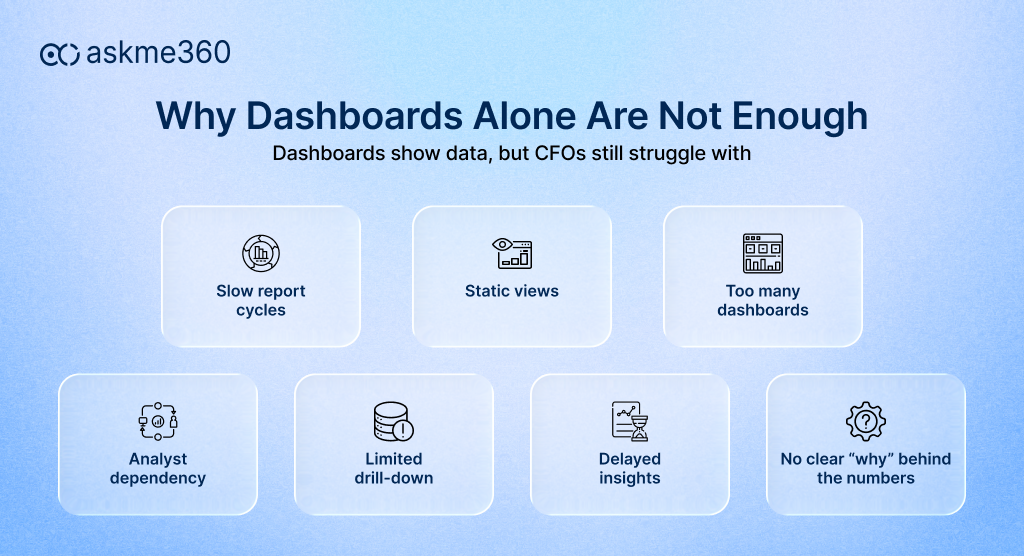
BI dashboards alone are not enough because CFOs need more than visibility. They need context, explanations, follow-up analysis, and decision-ready answers from ERP data. The challenge is not that dashboards are wrong, but that dashboards often stop at visibility, while CFOs need decision-ready answers.
A dashboard may show that operating expenses crossed budget. But it may not explain which department caused the variance, whether it is recurring, or whether the change is linked to vendor pricing, project delays, or unplanned consumption.
This is the pressure finance teams face every day. Static views lock you into predefined questions. You cannot ask something the dashboard was not built to show. Delayed data refresh means some reports run on yesterday’s data, or last week’s sync. Analyst dependency creates a bottleneck where every new question requires a ticket, a wait, and a formatted response.
Most ERP reporting environments still carry the same friction points:
- Static views
- Predefined metrics
- Limited ad-hoc analysis
- Delayed data refresh
- Too many dashboards
- Difficult drill-down
- Heavy dependency on analysts
- Data spread across ERP, databases, and business systems
- Manual interpretation before decision-making
As enterprise datasets grow, the problem becomes sharper. Businesses are not short of data. They are short of usable answers. With business growth, the dashboard sprawl gets worse, with more tools, more tabs, more confusion about which number to trust.
That is why CFO dashboard alternatives are gaining attention. CFOs do not want another screen. They want a faster path from question to action.
What is Conversational Analytics for ERP reporting?
Conversational analytics for ERP reporting allows CFOs and finance teams to ask business questions in natural business language and receive direct answers from ERP and database systems. Instead of navigating dashboards or waiting for reports, users can ask questions about cash flow, variance, receivables, payables, budgets, and performance.
In simple words, conversational analytics lets finance teams talk to their enterprise data. With natural language ERP reporting, users do not need to know report names, database structures, ERP navigation paths, or filter logic. They ask a business question. The system interprets it, connects with ERP data, and returns the answer in a usable format. And instead of waiting for a report, the system understands the question, queries the right data source, and surfaces an answer immediately.
This is not about replacing your ERP or discarding your existing reporting infrastructure. Conversational analytics sits as an intelligent layer on top of your existing data, whether it lives in Oracle EBS, SAP, PeopleSoft, or a centralised data warehouse. It translates business questions into data queries, executes them securely, and returns answers in a format that makes sense to a finance leader, not just a data engineer. This is not just a reporting upgrade. It is a workflow upgrade. It changes ERP reporting from a static review process into an interactive decision process.
What is the difference between AI and BI Dashboards for ERP reporting?
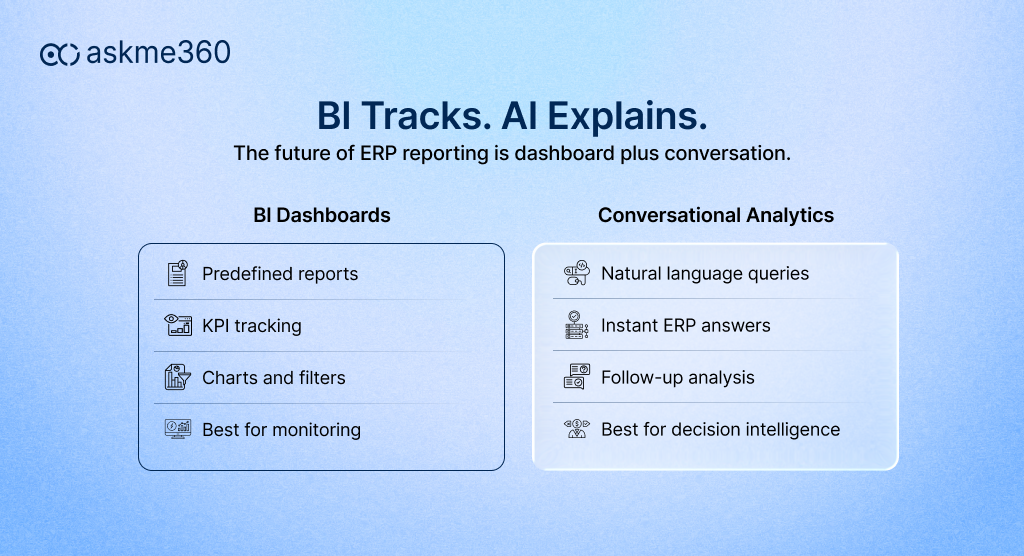
BI dashboards help users monitor predefined KPIs. Conversational analytics helps users ask new questions, explore exceptions, and get faster answers from ERP data. CFOs do not need to choose between AI and BI dashboards. The future of ERP reporting is not dashboard-only. It is dashboard plus conversation.
Here is the simplest way to understand the difference.
Field | BI Dashboards | Conversational Analytics |
User experience | Charts and filters | Plain-language questions |
Reporting style | Predefined reports | Ad-hoc answers |
Dependency | Often needs analysts or IT for new views | Reduces dependency on IT |
Speed | Good for monitoring | Better for instant follow-up questions |
Best use | KPI tracking | Decision intelligence |
Data interaction | Click, filter, drill down | Ask, refine, act |
CFO value | Visibility | Contextual answers |
Output | Dashboard view | Direct answer, report, summary, or export |
Flexibility | Limited to designed views | Open-ended business questioning |
Conversational analytics does not make BI irrelevant. It adds a faster decision layer on top of ERP reporting. That distinction matters. You still need dashboards for board packs, daily tracking, KPI monitoring, and management reviews. But you need conversational analytics when the business asks a question that was not designed into the dashboard. And that happens every day.
Why are CFOs moving towards Conversational Analytics?
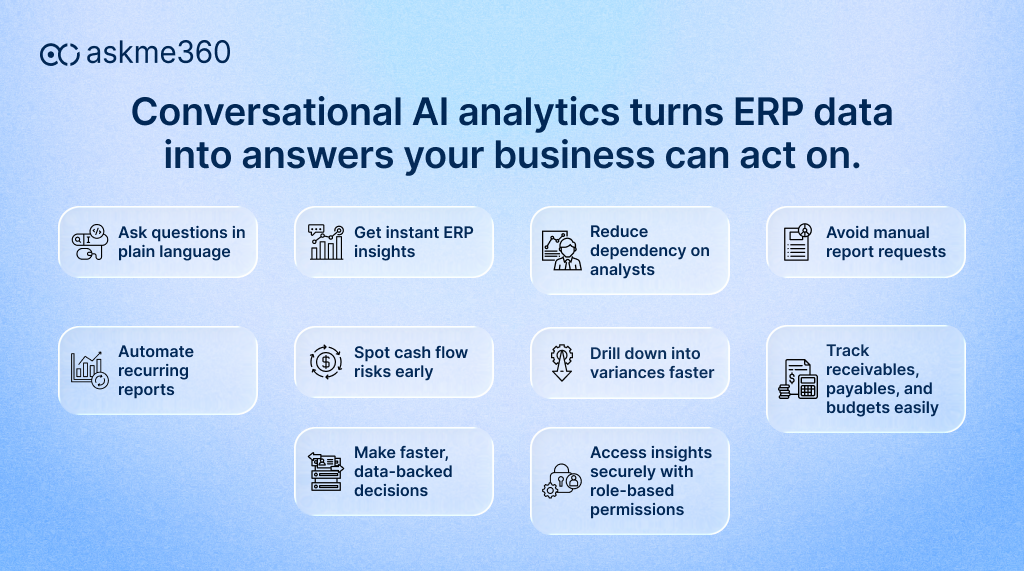
CFOs are moving toward conversational analytics because it gives them faster financial answers, reduces dependency on IT, improves variance analysis, and delivers real-time ERP insights without waiting for manual reports.
Finance is under pressure to become faster, leaner, and more strategic. CFOs now support pricing, profitability, risk, capital allocation, compliance, forecasting, and growth planning. That role cannot depend on slow reporting loops.
According to Gartner, 59% of finance leaders reported using AI in their finance function in 2025. Gartner also predicted that by 2026, 90% of finance functions would deploy at least one AI-enabled technology solution. McKinsey found that 44% of CFOs used generative AI for more than five use cases in 2025, up from 7% in the previous year. Deloitte also reported that 87% of CFOs expect AI to be extremely or very important to finance operations in 2026.
These numbers point to one thing. CFOs are no longer treating AI as an experiment. They are looking at it as an operating layer for modern finance.
Here is why conversational analytics is becoming a priority.
Faster access to financial answers
Instead of waiting for a scheduled report or an analyst response, a CFO can ask a direct question and get an answer in seconds. This matters enormously when a board presentation is three hours away.
Less dependency on IT and analysts
Finance teams spend an enormous amount of time translating business questions into data requests. Conversational analytics compresses this loop. Your team can explore ERP data analytics for CFOs without creating custom dashboards for every new scenario.
Better variance analysis
When numbers change, the natural response is to ask why. Conversational analytics supports that follow-up instinct directly. You can drill into exceptions, compare periods, and trace variances without leaving the conversation thread.
Real-time ERP-grounded insights
Answers come from live or near-live connections to your ERP and data systems, not cached summaries from last week. This keeps your real-time ERP insights genuinely current.
Role-based access and security
Not every question should have the same answer for every user. Conversational analytics platforms enforce permission structures, so a regional finance manager sees regional data, while the CFO sees the full picture. Access is governed, not guesswork.
Better board-level preparation
Preparing for a board meeting used to mean a Friday afternoon data pull followed by a weekend of formatting. With AI-powered financial reporting, that process compresses significantly, and the outputs are more accurate because they come directly from the source.
Conversational analytics - The future of ERP reporting
BI dashboards help CFOs see what happened. Conversational analytics helps them understand why it happened, what changed, and what action to take next.
The shift from dashboards to conversation is not a trend. It is a response to a real business problem.
CFOs cannot afford slow reporting cycles. They cannot depend on static views alone. They cannot wait days for answers when cash flow, cost, revenue, and risk are moving every day.
That is why AI vs BI dashboards for ERP reporting is such an important conversation for modern enterprises.
How does askme360 help with conversational analytics?
Heuristics Informatics Pvt. Ltd. brings deep enterprise technology experience across ERP, cloud, data, AI, managed services, and business transformation. With decades of experience in complex enterprise environments, HIPL understands a simple truth: businesses do not need more data noise. They need faster, safer, and clearer access to decision-ready intelligence.
askme360 is as an AI-powered ERP agent that helps business users ask questions in plain language and receive secure, role-based insights from ERP and enterprise data systems. For CFOs and finance teams, this means faster access to cash flow insights, vendor spend, receivables, budgets, variance, and operational performance without waiting for manual reports or dashboard changes.
With askme360, your business can move from static ERP reporting to conversational, real-time decision intelligence. It helps finance leaders unlock real-time ERP insights, automate reports, and work with enterprise data in the way business questions naturally arise: through conversation.
Frequently Asked Questions
What is the difference between BI dashboards and conversational analytics?
BI dashboards show predefined charts, KPIs, and reports. Conversational analytics allows users to ask questions in plain language and get direct answers from ERP and business data systems.
How does conversational analytics help CFOs?
Conversational analytics helps CFOs ask direct questions about cash flow, budgets, receivables, payables, revenue, variance, and working capital. It reduces reporting delays and improves decision speed.
Can conversational analytics replace finance reports?
Not completely. Standard finance reports are still needed for compliance, reviews, and documentation. Conversational analytics improves reporting by making ERP data easier to access, explore, and explain.
Is natural language ERP reporting secure?
It can be secure when the platform includes role-based access, user permissions, record-level controls, audit trails, SSO, and strong data privacy policies. Enterprise-grade governance is essential.