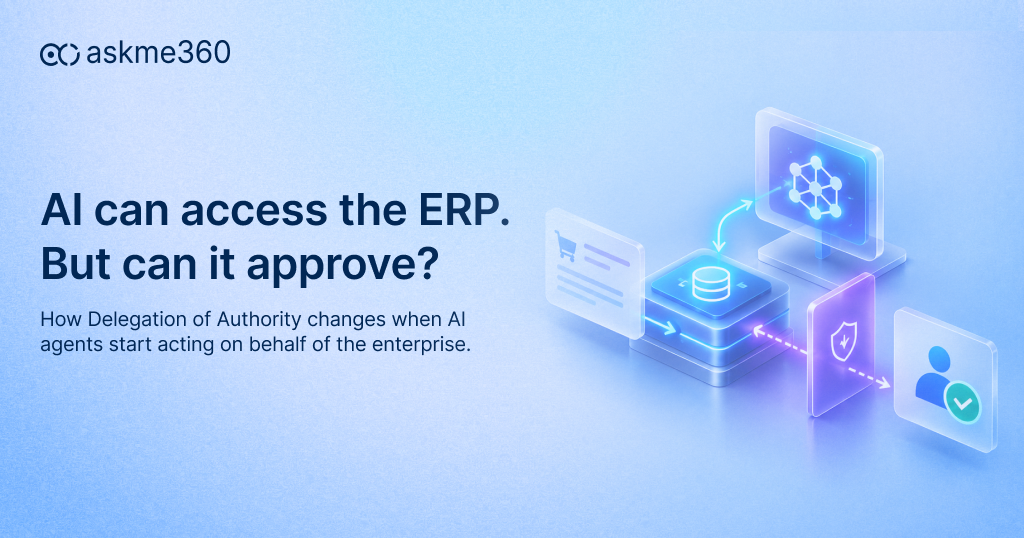
In today’s world, granting someone authority to approve transactions, delegation of authority, is like giving them keys to the company. It’s necessary for efficiency, but if that authority isn’t continually checked, problems can quietly pile up. This gap widens even more when we introduce AI agents that can act on our behalf in ERP systems. Suddenly, an invoice or purchase order could be processed by an AI assistant with no human clicking “approve.” Who makes sure that every action was truly authorized?
So, when an AI agent can read an invoice, check a policy, update an ERP record or trigger a workflow, the old approval model starts to look a little less complete. This is not just an automation challenge. It is a governance challenge.
What is delegation of authority in ERP?
Delegation of authority is the structure that manages who can make or approve certain business decisions within properly defined boundaries. In an ERP environment, that might mean a procurement manager can approve a purchase up to a certain value, while transactions with higher value need additional or higher approval. Similar rules can apply to vendor onboarding, expenses, purchase orders, contracts, payments and other financial or operational decisions.
The purpose is straightforward; give people enough authority to keep business moving without giving anyone unlimited decision rights. That makes delegation of authority in ERP an important part of enterprise risk management. It creates accountability, supports separate responsibilities and gives auditors a structure for making out if decisions were made within approved boundaries.
Nearly 90% of companies have formal DOA policies, underscoring its importance. A well-designed DOA framework can boost efficiency, accountability, and trust. But as one EY study warns, if DOA policies are poorly updated or enforced, “mistakes in these areas can be costly for an organization”, leading to compliance failures or reputational damage.
How does delegation of authority work with AI agents?
A traditional ERP workflow generally follows some pre-made rules. A transaction enters the system, conditions are checked and the appropriate person or group receives an approval request. An agentic system however can do much more. It can understand a request, get information, use enterprise tools and execute multiple steps to complete a task.
That changes the control question from:
“Does this user have access?”
to:
“Is this agent authorized to perform this specific action, in this specific context, on behalf of this person or business process?”
That difference is becoming important enough that governance bodies are treating AI agents for ERP as a new category of enterprise identity. This is where identity access management becomes part of the business-control conversation.
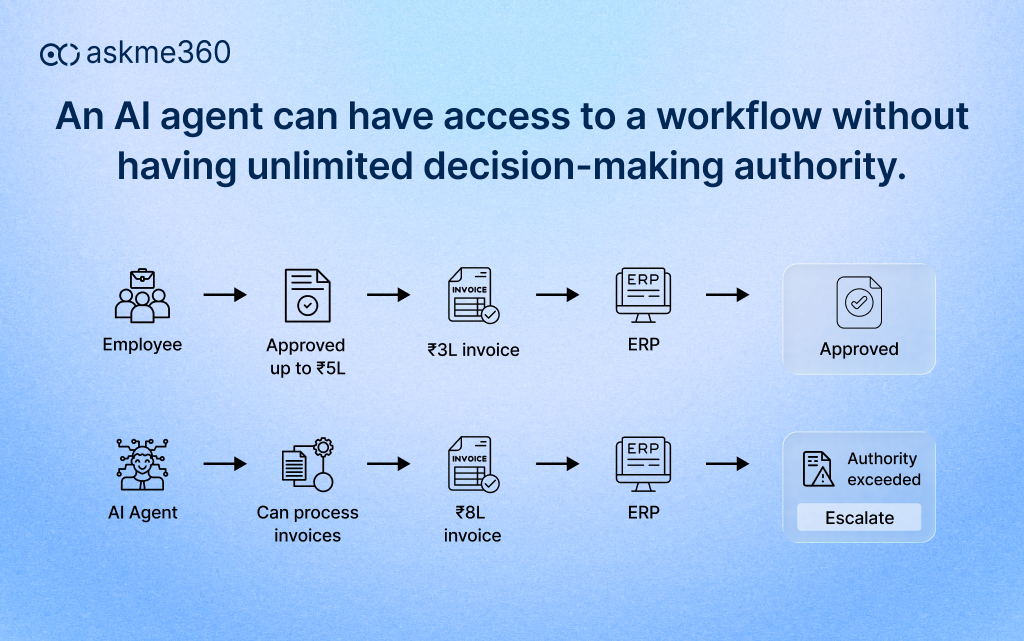
An AI agent may have permission to read invoices. That does not automatically mean it should be allowed to approve payments. An agent that can create a purchase request should not necessarily be able to approve its own request. So, an agent needs boundaries just as much as an employee does.
How do AI agents affect approval workflows?
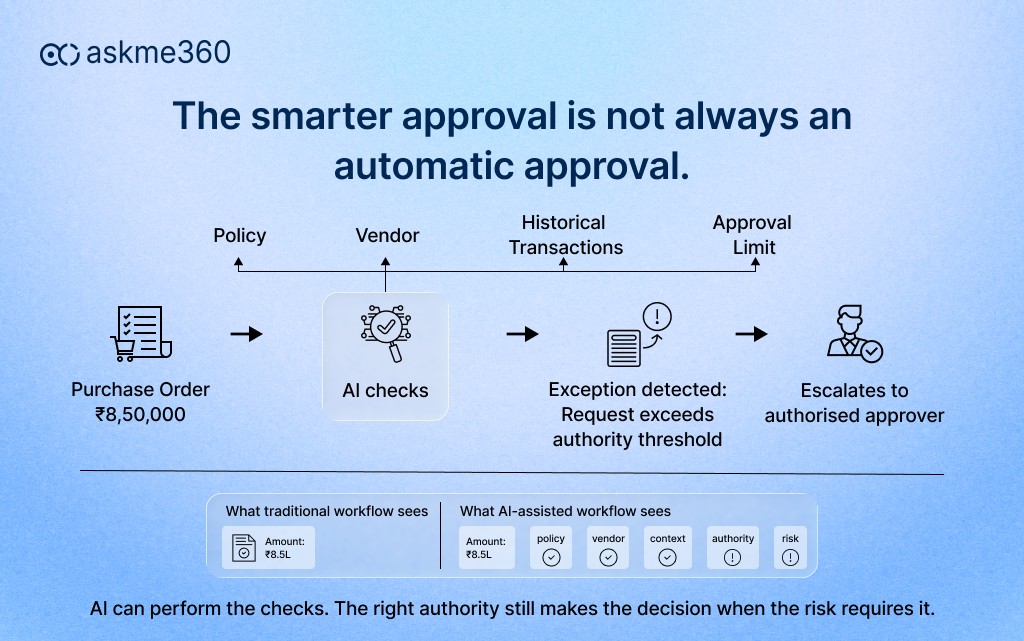
AI does not always eliminate approval workflows. In established enterprises, it can make them more intelligent. Think of a conventional purchase approval. A purchase order is raised. The ERP checks the amount. The workflow then takes it to the designated approver. The approver reviews it and finally clicks approve.
Now what happens if you introduce an AI agent?
The context aware AI agent could first check the purchase against the relevant policy, vendor information, historical transactions, approval limits and business context. It could identify that the amount exceeds the requester’s authority, that the vendor is not approved for that category or that the transaction creates a conflict. Instead of making the finance team discover the problem later, the exception can be brought up at the point where it matters.
This is the opportunity behind ERP approval workflow automation, not simply moving approvals faster but making the controls around those approvals more contextual and appropriate against business policies.
Deloitte’s analysis of AI observability and monitoring describes the broader need for visibility into AI-system activity. For enterprises, this means understanding what an agent intends to do, which systems it will affect and whether the action complies with relevant policies before execution.
The goal is not “remove humans from approvals.” The goal is “stop making humans manually perform checks that a system can perform continuously, while keeping meaningful human accountability where risk requires it.”
How should enterprises govern AI agents in ERP?
The first rule is simple, do not give an AI agent more authority than the task requires. So, how to govern AI agents in ERP? Start by applying least privilege access to AI agents, defining what each agent can access, which actions it can perform and under what circumstances. For an ERP environment, enterprises should consider at least five layers of control:
1. Identity
Every agent should have an identifiable owner, purpose and identity.
2. Permission
Use role-based access control for AI agents to define what the agent can read, create, modify or execute.
3. Context
An AI agent may be allowed to process an invoice but not release a high-value payment.
4. Segregation
Apply segregation of duties for AI agents just as you would for human employees.
5. Evidence
Every material action should be traceable, this includes knowing what happened, why it happened, what policy applied, what information was considered and who was accountable for the outcome.
Who approves actions taken by AI agents?
An AI agent can execute an action within a defined authority. But the organization still needs to define who owns that authority and what conditions govern its use. For low-risk, repetitively mundane activities, an agent may be allowed to execute automatically when predefined controls are satisfied properly. For higher-risk heavy actions, the workflow may require human review or additional authorization.
For example –
1. Invoice received
2. AI validates invoice
3. Policy check
4. Within approved threshold
5. Process
But:
1. Invoice received
2. AI validates invoice
3. Policy check
4. Above authority threshold
5. Escalate to authorized approver
That difference is important. Agentic automation should not turn a policy into a suggestion. Organizations should be able to trace the delegation chain from the human request through the agent, tools and systems involved, and identify who owns the outcome. This is also where agentic AI governance in ERP becomes realistic. Governance should exist before the agent acts, not only after an auditor discovers an exception.
What changes when AI can act inside the ERP?
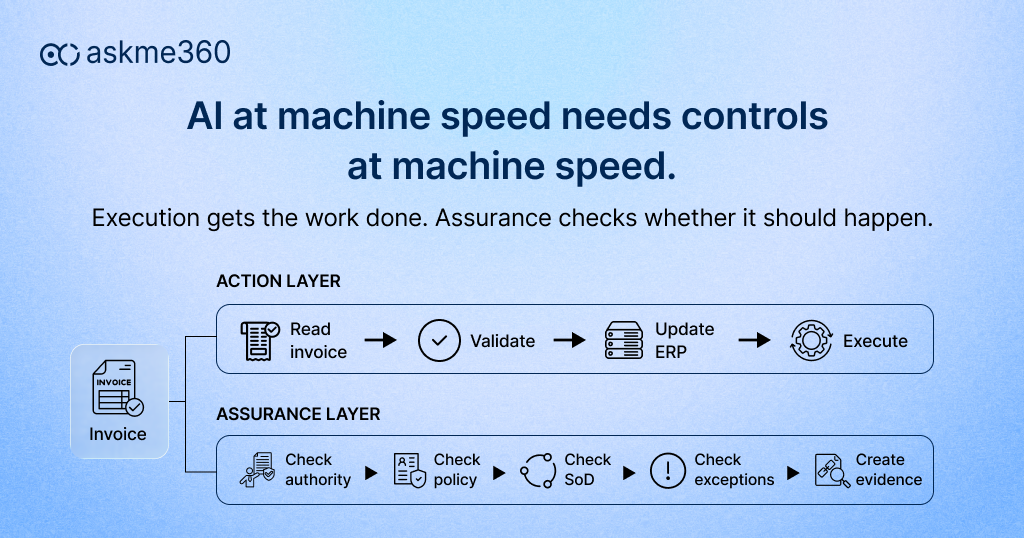
The biggest change is speed. A human employee may take hours to review a set of transactions. An agent can evaluate many records as part of an automated workflow. That is a major efficiency opportunity, but it also means a poorly governed rule can be applied at machine speed. The risk is therefore not simply that AI might make a bad decision.
It is that a bad decision can scale quickly. This is why modern AI workflow automation needs an assurance mechanism alongside execution. Enterprises need to determine where agents can operate, what decisions they can make, how their actions can be constrained and what evidence is required to demonstrate control. Automate the work. Do not automate accountability.
How can enterprises make agentic ERP controls continuous?
A quarterly review can tell you what happened during the previous quarter. A continuous control can help identify what is happening now.
For example, instead of asking during an audit-
“Did anyone approve purchases above their authority limit?”
An enterprise could ask:
“Are any transactions currently being processed outside the approved authority structure?”
That shift, from retrospective checking to continuous assurance, is particularly relevant to finance, procurement, internal audit and risk teams. Delegation of authority remains the foundation of that process. What changes is how the organization applies it, instead of relying only on static approval matrices and periodic checks, enterprises can move towards controls that assess activity against defined policies as it happens.
The future of ERP governance will not be built around giving AI unlimited autonomy or keeping every decision manual. It will be about defining clear authority, limiting access, separating responsibilities, continuously checking activity and maintaining enough evidence to explain every material action.
For enterprises adopting agentic systems, the winning model is not AI instead of control. It is AI with control built in.
How askme360 connects assurance with action
This is where the distinction between an AI system that does the work and one that helps govern the work becomes important.
askme360 brings these two capabilities together through its action layer and assurance layer.
The Action Layer uses agentic pipelines to execute defined work inside enterprise systems. An invoice or receipt can be read, validated against policies and posted into an ERP. Bank statements can be matched against ledger entries and discrepancies surfaced. Emails can be interpreted and used to update records or trigger defined workflows.
But execution alone is not enough for an enterprise that cares about governance.
The Assurance Layer provides the reasoning layer around that execution. Organizations can configure their own policies and controls so the system can examine transactions and business activity for issues such as:
- Approvals beyond defined limits
- Bypassed approval hierarchies
- Segregation-of-duty conflicts
- Off-policy procurement
- Unapproved vendors
- Missing compliance requirements
- Internal-control exceptions
The value is not simply that an AI agent can take action. It is that the organization can establish a stronger connection between policy, evidence, exception and action.
The two layers work towards a more controlled process, the action layer executes defined tasks, while the assurance layer helps identify where business activity may fall outside established policies. Human accountability and the organization’s approval requirements remain central to how those actions are governed. With askMe360, the focus is not just on making enterprise work faster. It is on connecting execution with assurance, so organizations can take advantage of automation while keeping authority, policy and accountability in view.
Because when AI starts doing the work, knowing that it can act is only half the question. Knowing that it is acting within the right boundaries is what makes enterprise AI security a top priority.
Frequently Asked Questions
What happens to Delegation of Authority when an employee delegates their approval to an AI agent?
The original authority remains with the authorized person; the agent can only act within the permissions and conditions assigned to it.
Can an AI agent have its own approval limit?
Yes. Organizations can define specific transaction limits for an agent based on its role, purpose and risk level.
What happens if an AI agent acts outside its assigned authority?
The action should be flagged as an exception and stopped or escalated according to the organization’s controls.
Can AI agents create conflicts in existing approval structures?
Yes. If an agent can initiate and approve the same transaction, it can create a segregation-of-duties conflict.
What should an audit trail capture for an AI-driven ERP transaction?
It should capture the action, the agent involved, the authority used, the applicable policy and the resulting decision.