AI has quietly moved from being a future idea to a daily business reality. Today, it helps leaders review numbers, spot risks, understand trends, and make decisions faster than ever before. What earlier depended on reports and meetings now often starts with a simple question.
That speed is valuable. But it also makes many organisations pause. Because the moment AI starts touching enterprise data, the conversation shifts. It is no longer just about insights and efficiency. It becomes about trust. About knowing your data is safe. About being confident that faster decisions do not come at the cost of control.
This is why enterprise data security and AI data privacy matter so much in AI-driven decision making.
AI changes how enterprises handle data
Not long ago, enterprise data stayed fairly contained. ERP systems stored information. Analysts prepared reports. Leaders reviewed them on a schedule. It was slow, but it felt predictable.
AI has changed that rhythm completely. Now, data is accessed continuously. AI connects finance, HR, procurement, and operations data in real time. Insights are generated the moment you ask for them. Decisions move quickly, often while the situation is still unfolding.
This is exactly why businesses are adopting AI. But it also means data is being touched more often, by more users, and in more contexts than before.
Gartner estimates that by 2026, more than 80 percent of enterprises will rely on AI-assisted decision-making. Yet many are still catching up on enterprise AI privacy and governance. That gap is where uncertainty begins.
Setting clear boundaries with enterprise data privacy
Enterprise data privacy is about boundaries. It defines who can see what, and why.
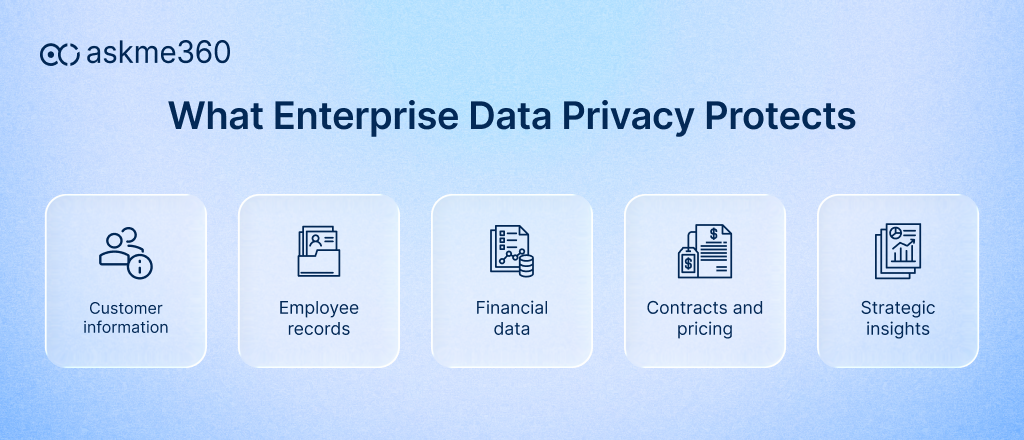
Every organisation handles sensitive information. Customer records. Employee details. Financial data. Contracts. Strategic plans. Privacy ensures this information is accessed only by people who genuinely need it to do their job.
In an AI-driven environment, privacy becomes even more important. AI naturally looks across systems. Without clear rules, that ability to connect data can expose information more widely than intended.
Strong enterprise data privacy makes sure that:
- Access is purposeful, not accidental
- Sensitive data is not overexposed internally
- Privacy rules are consistent, not ad hoc
Privacy is not about blocking data. It is about using data responsibly.
AI Data Privacy vs AI Data Security
If AI data privacy defines who can see data, AI data security ensures no one else can. These two terms are often used together, but they solve different problems.
Enterprise Data Privacy
AI data privacy focuses on who can see data, under what conditions, and for what purpose.
It ensures that:
- Sensitive financial, employee, and customer data is not exposed
- Access aligns with business roles
- Data is not shared without consent or control
- Regulatory and contractual obligations are met
Privacy is about control and intent.
AI data security
If privacy decides who should see data, enterprise AI security makes sure no one else can.
Security focuses on protecting enterprise data from breaches, misuse, and loss. This includes safeguarding data when it is stored, when it is accessed, and when AI systems process it to generate insights.
In practical terms, enterprise AI security depends on:
- Strong authentication
- Role-based access controls
- Encryption in transit and at rest
- Continuous monitoring and logging
Security is what allows AI to work at speed without putting the business at risk.
Importance of Governance in Speed
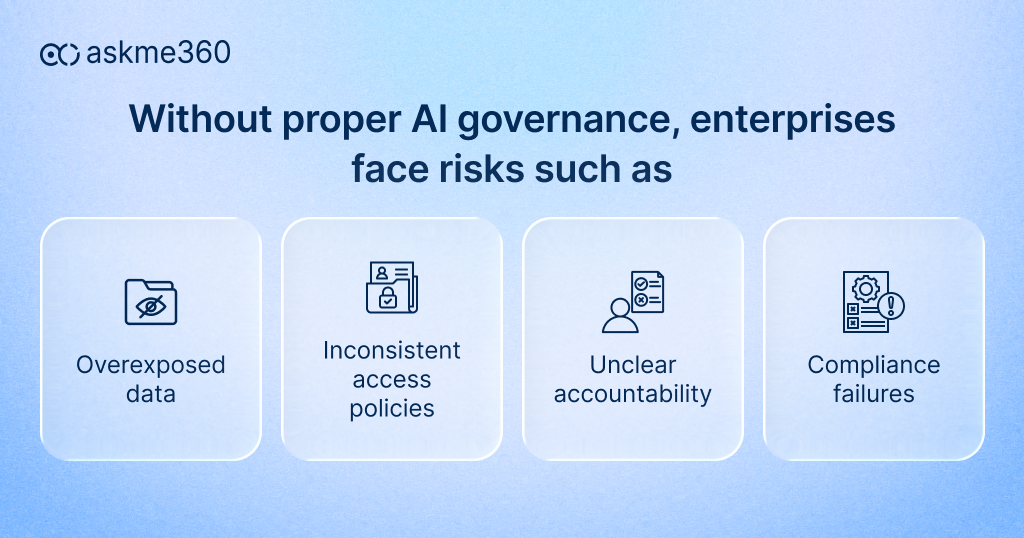
AI speeds up decision-making. Governance keeps it safe. Without clear AI governance, organisations often face issues such as uncontrolled access, unclear accountability, and compliance gaps. None of these show up on day one. They surface later, usually during audits or incidents.
A simple analogy works well here.
AI is like moving from driving on local roads to a high-speed expressway. You reach your destination much faster. But without rules, signals, and guardrails, accidents are inevitable. Governance provides those guardrails. It defines how AI is used, what data it can access, and how decisions remain explainable.
Privacy-first architecture
One of the biggest mistakes organisations make is treating security as something to “add later.” In reality, the safest AI systems are designed with privacy at the core.
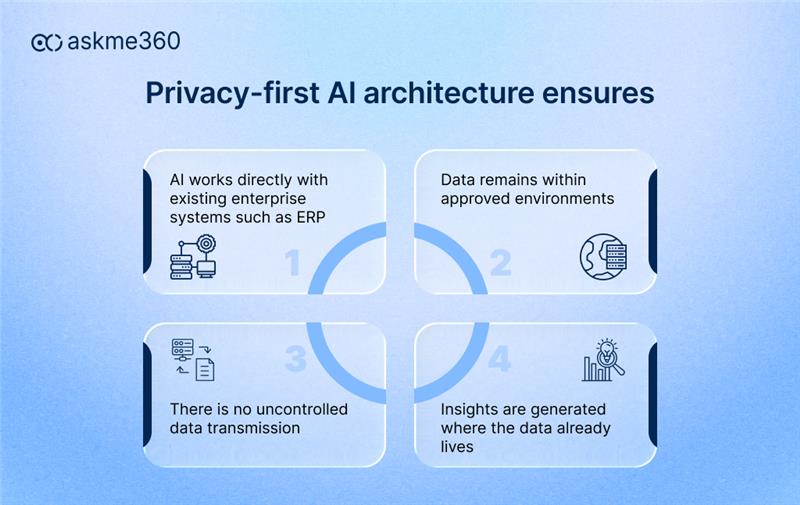
A secure AI solution should:
- Work directly with enterprise systems such as ERP
- Avoid unnecessary data movement or duplication
- Keep data within approved environments
- Prevent uncontrolled sharing with external models
In simple terms, AI should work where your data already lives. This approach significantly reduces risk and strengthens data privacy in AI deployments.
Access control keeps AI useful
AI makes data easier to access. That is its strength. But access without limits quickly becomes a problem.
Strong enterprise AI privacy relies on:
- Role-based access so users see only what they need
- Record-level controls for sensitive information
- Consistent policies across departments
Finance teams should see financial data, not HR records. HR teams should see workforce data, not vendor pricing. Operations teams should see inventory and production data, not payroll.
When AI respects these boundaries automatically, security supports productivity instead of slowing it down.
However, AI-driven decision making does not remove human responsibility. The most successful organisations use AI to highlight patterns, surface risks, and suggest priorities. But final decisions stay with people.
This human-in-the-loop approach keeps accountability clear and aligns naturally with enterprise data privacy and governance principles. AI supports decisions. It does not silently make them.
Why is SOC-compliant AI essential
Compliance often sounds restrictive. In reality, it builds confidence. A SOC compliant AI platform shows that security controls, monitoring, and governance are part of everyday operations, not last-minute checks.
Such platforms offer:
- Clear separation of duties
- Continuous audit trails
- Strong access controls
- Reliable documentation
PwC reports that organisations with mature security and compliance practices face 30 to 40 percent fewer data-related incidents during digital transformation. Discipline reduces surprises. And fewer surprises mean smoother decisions.
Auditability - the most important requirement
Sooner or later, someone will ask a simple question.
“If AI gave this insight, can we explain how?”
Auditability answers that question. Enterprise AI systems must record who accessed what data, which questions were asked, and how insights were generated. This becomes critical during audits, reviews, and regulatory discussions.
Auditability turns AI outputs from assumptions into defensible business decisions.
The hidden challenge of shadow AI
When teams do not have access to trusted, secure AI tools, they find alternatives. Data gets uploaded into standalone tools. Governance gets bypassed unintentionally. This is known as shadow AI.
The solution is not tighter restrictions. It is offering secure AI solutions that are easy to use and properly governed. When the right tools exist, shadow usage fades away.
Bringing it all together
Ensuring AI data privacy, AI data security, and effective AI governance is not about slowing down AI adoption. It is about making AI sustainable.
When privacy and security are built into AI-driven decision making, businesses move faster with confidence. Teams collaborate without fear. Compliance becomes routine. AI becomes a reliable partner. Most AI discussions focus on efficiency and speed. But the real value lies elsewhere. Strong enterprise AI security builds trust.
Trust that data is protected.
Trust that access is controlled.
Trust that insights are reliable.
IDC research shows that organisations which trust their analytics platforms are twice as likely to act on insights compared to those dealing with fragmented or insecure systems. Trust accelerates decisions. Doubt delays them. That is when AI delivers real enterprise value.
askme360 ensures enterprise data security and privacy
With over three decades of experience in enterprise IT, Heuristics Informatics Pvt. Ltd. (HIPL) has worked closely with organisations to solve complex data, security, and transformation challenges.
Built on this foundation, askme360 is a privacy-first, SOC compliant AI platform designed for AI-driven decision making inside ERP environments. It lets leaders ask business questions in simple language and get real-time insights, while keeping enterprise data private, protected, and fully governed.
askme360 proves that speed and security do not have to be trade-offs. With the right design, you can have both.