Conversational AI is often misunderstood as just another form of automation or a smarter chatbot. In reality, it represents a multi-faceted aspect in how enterprises interact with data. At its core, Conversational AI allows humans to communicate with complex systems using natural language, just as they would with a colleague. You ask a question. The system understands intent, context, and urgency. Then it responds with a clear, relevant answer drawn directly from live enterprise data. This may sound simple, but its impact on decision-making is profound.
In this blog, we explore deeper Conversational AI and how it enables real-time enterprise decision making.
What is different with Conversational AI?
When most people hear the term AI, they think of automation, algorithms, or systems quietly working in the background. Useful, yes, but distant. Traditional AI often operates behind dashboards, scripts, and technical layers that only specialists understand. In enterprises, it often works in isolation, forecasting demand, flagging anomalies, or optimizing pricing models. However, access to those insights still depends on dashboards, reports, or specialist teams. In other words, the intelligence exists, but it is locked behind interfaces and processes.
Conversational AI removes that final barrier. It lets you talk to systems the way you talk to people, using plain language instead of commands, codes, or dashboards.
- You ask a question.
- The system understands your intent.
- It pulls the right data.
- And it responds in clear, human language.
- No technical skills required.
This AI meets humans where they are. It allows people to interact with complex systems using natural, everyday language, spoken or written, just as they would with a colleague. You don’t adapt to the system. The system adapts to you. Instead of asking people to learn systems, Conversational AI learns people. It understands how business users think, how leaders frame questions, and how decisions are actually made.
This is why Conversational AI is increasingly seen as AI for non-technical users, even in highly complex enterprise environments. The result is not smarter algorithms alone, but faster and more confident decisions across the organization.
From static intelligence to live conversations with data
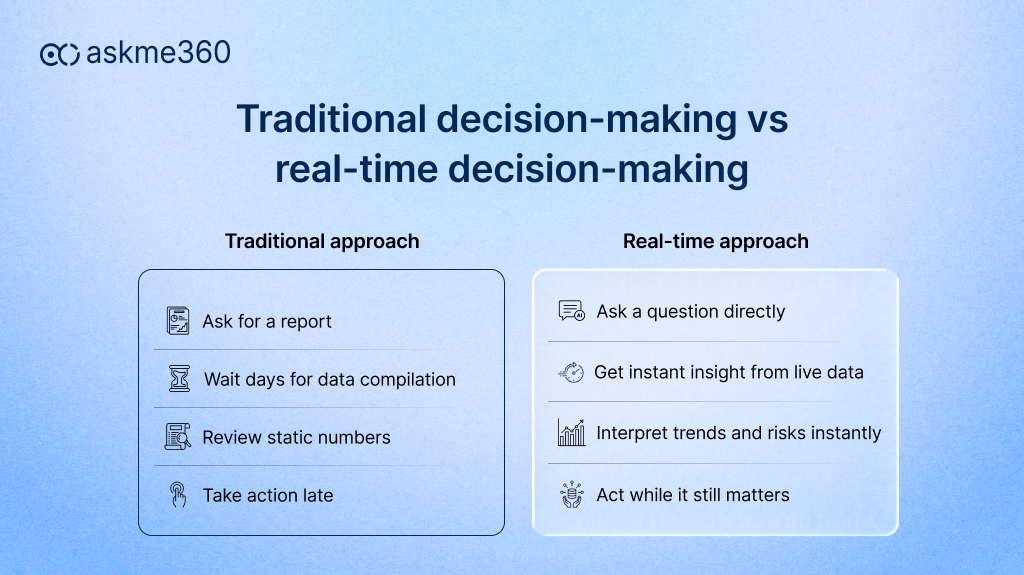
What makes Conversational AI fundamentally different from “simple AI” is interaction. Traditional AI analyzes data and produces outputs. Conversational AI engages with you. It understands follow-up questions, adapts to changing context, and allows exploration in real time. You are no longer locked into predefined reports or static dashboards. Instead, decision-making becomes a dialogue.
This shift matters because enterprises today operate in environments that change by the hour. Markets fluctuate, supply chains shift, customer expectations evolve, and risks emerge without warning. Waiting for scheduled reports or manually prepared analyses no longer works. Real-time enterprise decision-making demands immediate access to accurate information, without technical barriers.
Conversational AI enables this by sitting directly on top of enterprise systems such as ERPs and CRMs. When you ask a question, the AI translates your intent into queries, scans massive volumes of structured and unstructured data, and returns answers in seconds. There is no need to extract data, clean spreadsheets, or interpret charts before acting. Decisions happen while events are unfolding, not after the fact.
More importantly, Conversational AI does not stop at describing what is happening. By continuously learning from historical and live data, it identifies patterns and predicts outcomes. Leaders can move from asking “What happened?” to “What is likely to happen next?” and “What should we do now?” This predictive capability transforms decision-making from reactive to proactive. Risks are spotted earlier. Opportunities surface sooner. Strategy becomes dynamic instead of static.
Conversational AI and automation
Another critical dimension of Conversational AI is automation. Advanced systems can trigger actions based on real-time insights. When thresholds are crossed or anomalies detected, workflows can be initiated automatically. This reduces the lag between insight and execution, which is often where enterprise value is lost. Decisions are not just informed faster, they are acted on faster.
Simple AI focuses on efficiency within a process. Conversational AI focuses on decision enablement across the enterprise. Consequently, it does not just answer what happened. It helps you understand why it happened, what it means for your business, and what actions you should consider next. Because it operates on live data and understands context, Conversational AI supports decisions while they still matter.
Interface for real-time enterprises
Real-time enterprises operate on continuous signals, not periodic reviews. Customer expectations shift instantly. Supply chains change daily. Financial risks emerge without warning.
Here, Conversational AI becomes the interface that allows leaders to keep pace with this reality. Instead of reviewing static outputs, they interrogate the business live. They explore scenarios, test assumptions, and adjust strategy as conditions evolve.
This is why Conversational AI for enterprise is increasingly viewed as a strategic layer, not a functional add-on.
Democratizing intelligence across organization
Yet perhaps the most transformative impact of Conversational AI lies in data democratization.
For decades, enterprise data has been accessible only to a small group of analysts and technical experts. Business users depended on intermediaries to interpret information for them. This created bottlenecks, slowed decision-making, and limited organizational agility. Conversational AI removes these barriers by making data accessible to everyone, regardless of technical skill.
When employees across finance, operations, HR, and leadership can ask questions in plain language and receive trustworthy answers instantly, data stops being intimidating. It becomes usable. This is what true data democratization looks like. As a result, insight is no longer centralized. Intelligence spreads across the organization, empowering teams to make informed decisions within their own contexts.
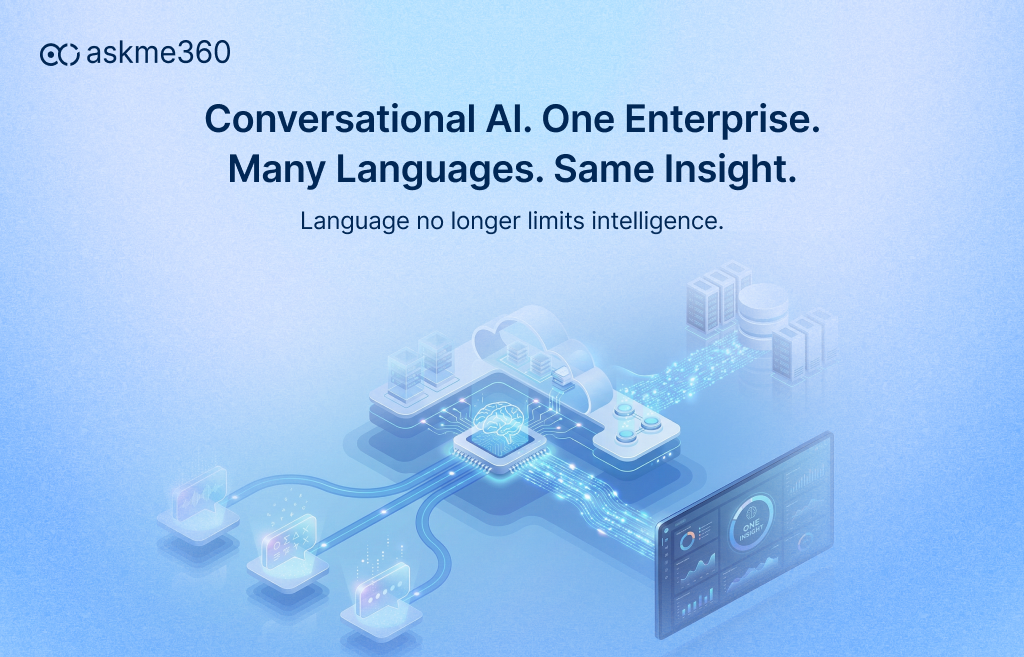
Furthermore, multi-language AI strengthens this effect. In global enterprises, language differences often restrict access to insights. Conversational AI allows users to interact with systems in their preferred language, ensuring that decision-making power is not limited by geography or linguistic ability. As a result, enterprises gain consistency, speed, and inclusivity at scale.
The Business Impact
According to Gartner, by 2026, Conversational AI adoption in enterprise environments is expected to drive tens of billions of dollars in cost savings, particularly in customer operations.
Leaders have moved away from reviewing static reports and debating data freshness. Instead, they engage directly with live enterprise data, ask sharper questions, and explore insights in real time. This does not replace experience or judgment. It amplifies it. Conversational AI gives leaders clarity instantly when decisions are required, not days later.
Organizations that have matured in their adoption report faster decision cycles, significant reductions in resolution times, and consistently higher satisfaction scores. These gains reflect a structural shift in how enterprises operate, not incremental improvement.
askme360 brings Conversational AI to enterprise decision-making
askme360 is designed as a Conversational AI layer on top of enterprise ERP systems. It allows you and your teams to ask business questions in natural language and receive accurate, real-time answers from your own data, without dashboards, queries, or analyst dependency.
By combining Conversational AI for enterprise with real-time business intelligence, askme360 helps organizations move beyond simple AI use cases. It enables enterprise AI insights to reach decision-makers instantly, securely, and at scale.
Your ERP already holds the intelligence your business needs. askme360 ensures you can access it through conversation, at the speed modern enterprises demand.
In the future, competitive advantage will not come from having more data, but from how clearly you can talk to it.