If AI is already everywhere, why do decisions still feel so slow?
This is a question many business leaders ask quietly, often after another review meeting ends with “let’s get a detailed report.” On paper, enterprises are more data-rich than ever. ERP systems are mature. Business intelligence AI tools are widespread. Enterprise AI solutions are no longer new.
And yet, decision-making still feels heavier than it should.
A Gartner study shows that organizations using AI only for reporting and automation still experience decision delays of up to 40% because insights lack continuity and business context. In other words, the data exists, but the understanding does not flow.
As we move toward 2026, this gap between information and action is becoming impossible to ignore. Therefore, the missing link is not more AI, context aware AI.
Slowed Down Enterprise Decisions
Enterprise decisions rarely begin and end with a single question. They unfold over time. A business head looks at cash flow trends and then naturally asks what is driving the change. An operations manager reviews system costs and wants to understand which applications are inefficient. A Sales Head sees performance figures and asks what risks are building beneath the surface.
These are connected questions. They belong to the same decision thread. However, most AI in enterprise systems still treat them as isolated requests. Every new question resets the system. The earlier context disappears. Business intent gets lost. Decision momentum slows down.
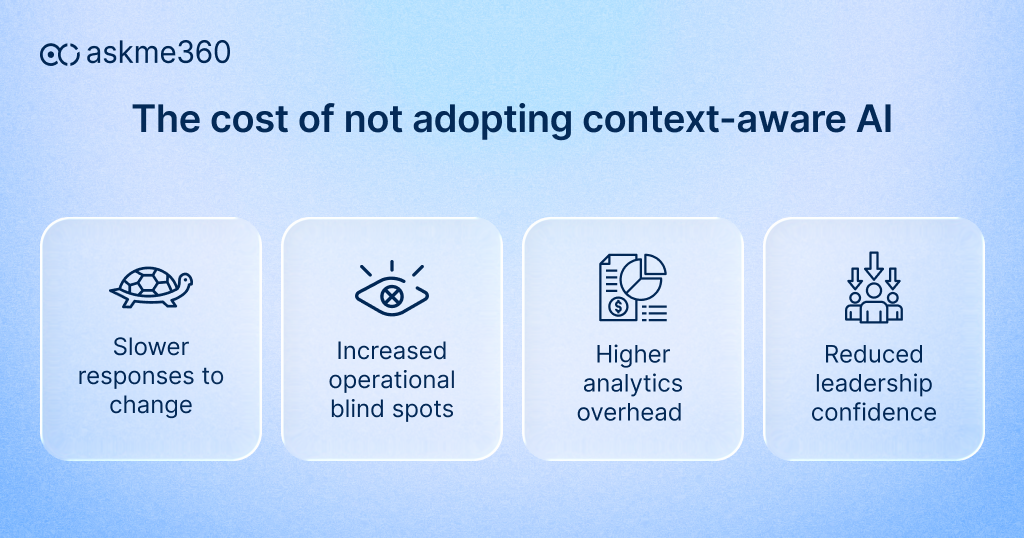
According to IDC, large enterprises lose over 35,000 productive hours each year simply reconnecting reports, dashboards, and explanations. This is not a people problem. It is a context problem.
What is Context-Aware AI?
Modern AI systems are not limited to processing raw inputs and producing fixed outputs. Today’s intelligence uses real-time situational data to understand where, when, and how information is being generated, and what it means in that specific moment. This allows decisions, predictions, and responses to adapt as conditions change.
Signals such as time, location, user behaviour, system status, and interaction patterns all shape how the AI responds. Unlike traditional models that follow static logic, this approach continuously recalibrates itself based on context. The same question can lead to different insights depending on timing, urgency, or business conditions.
You already experience this in smart assistants, recommendation engines, autonomous systems, and healthcare technology, where responses feel personalised rather than generic. In enterprise environments, this ability helps AI align insights with real business situations, making decisions more relevant, timely, and actionable.
How does context aware AI benefit
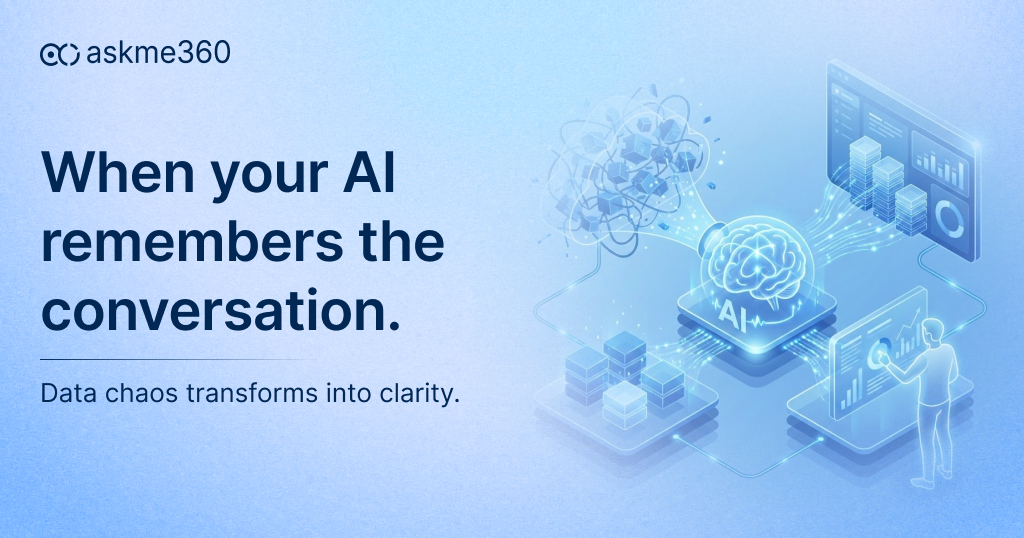
Context-aware AI understands that enterprise decision-making is conversational, not transactional. It remembers what you asked earlier, understands the time period you are discussing, and recognizes your role in the organization. Most importantly, it understands why the question is being asked.
Instead of answering in fragments, it builds continuity.
When you explore data with context aware AI, the experience feels closer to a discussion with a trusted analyst than a search query. The AI follows your line of thinking. It adapts as the conversation evolves. It connects insights across finance, operations, procurement, and HR without forcing you to restate everything.
This continuity is what transforms AI from a reporting engine into a decision partner.
Context matters more than intelligence
No doubt, AI is extremely capable at calculations, predictions, and pattern detection. But intelligence without context often leads to shallow answers.
For enterprise leaders, shallow answers are dangerous. A number without explanation creates hesitation. A chart without narrative leads to debate. A trend without business impact delays action. Context aware AI bridges this gap by linking numbers to meaning.
McKinsey reports that organizations using insights with contextual reasoning improve AI driven decisions quality by 20 to 25 percent, especially in complex, cross-functional decisions. The improvement does not come from smarter algorithms alone. It comes from AI understanding how business questions evolve.
From static reporting to AI driven decisions
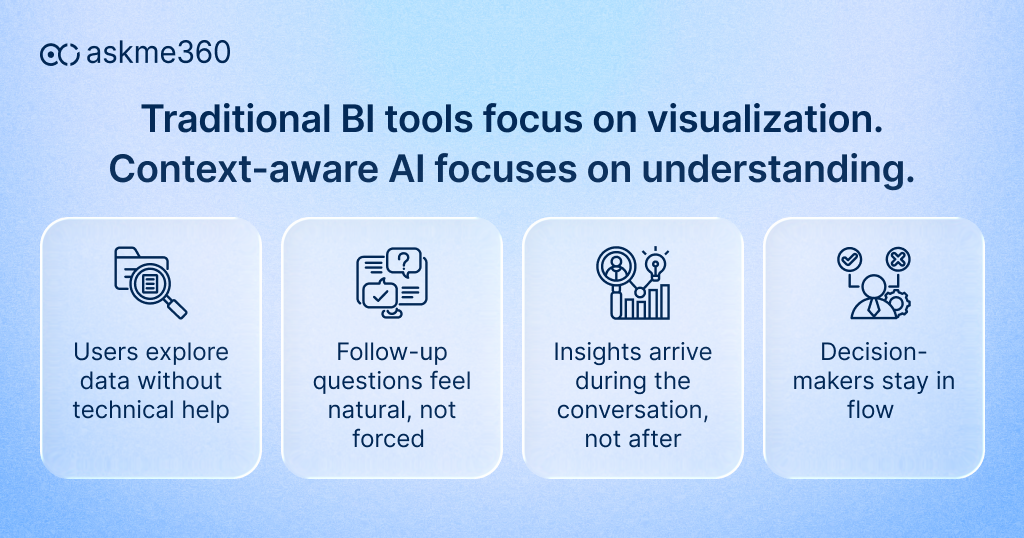
Traditional business intelligence AI focuses on dashboards. These dashboards are useful, but they freeze insights at a point in time. They rarely support exploration.
With context-aware AI, instead of consuming reports, you interact with your data. Instead of switching tools, you stay within one continuous conversation. Instead of waiting for revised outputs, you get real time analytics that adapt to your questions.
This shift matters because enterprise decisions are no longer periodic. They are continuous. Leaders do not wait for month-end reviews to act. They need clarity during discussions, meetings, and planning sessions. Context aware AI delivers that clarity when it matters most.
Real-time analytics need context to be useful
Real time analytics sound powerful, but without context they often overwhelm decision-makers. Numbers update. Alerts trigger. Dashboards refresh. Yet the question remains as to what should I do about this?
Context-aware AI adds meaning to real-time analytics. It explains what changed, why it matters, and what risks or opportunities may follow. It aligns live data with business intent.
PwC estimates that enterprises combining real-time analytics with contextual AI reduce operational inefficiencies by up to 30 percent. The gains come not from speed alone, but from relevance.
Security and Governance
For senior leaders, speed can never come at the cost of control. Context-aware AI is not about opening data to everyone. It is about delivering the right insights to the right people.
By understanding user roles, permissions, and data sensitivity, context aware AI respects enterprise governance while still enabling agility. Leaders gain visibility without compromising compliance. Teams gain clarity without overexposure.
Context is the foundation of better decisions
By 2026, Enterprise AI solutions will be more complex, not less. Data volumes will continue to grow. Regulatory scrutiny will intensify. Decision cycles will shrink further.
In this environment, AI that simply answers questions will feel outdated. AI must understand conversations, intent, and continuity.
Enterprise AI solutions will move faster with greater confidence. Those that rely on fragmented insights will struggle to keep pace, no matter how advanced their tools appear on paper.
Context will become the true differentiator.
askme360 - Enabling context-aware decisions
askme360 is built specifically to bring context aware AI in enterprise environments. It works as a conversational AI layer on top of your ERP systems, allowing you to ask questions in natural language while preserving the full context of your conversation.
By remembering prior queries, understanding user roles, and connecting live ERP data, askme360 delivers AI-driven real time analytics. This helps your teams reduce reporting delays, remove dependency on analysts, and make faster, more confident decisions.
For enterprises preparing for 2026 and beyond, askme360 turns data into continuous, context-aware decision intelligence, securely, responsibly, and at enterprise scale.