
For years, artificial intelligence sat on the edges of business conversations, an interesting concept, a promising technology, something “big companies” or “tech-first enterprises” would experiment with. That era is over.
Today, AI has moved from the margins to the centre of business strategy. And the organisations adopting it early are already rewriting the rules of competitiveness, operational efficiency, and leadership excellence.
Early AI adoption is no longer a technological advantage. It is a strategic advantage. It is the launchpad for businesses that want to lead the future, not simply adapt to it.
In this blog, we explore how AI adoption is reshaping global industries, why early adopters consistently outperform late movers, and how your organisation can turn enterprise AI into a long-term growth engine.
The urgency behind AI adoption
Every business leader today is navigating unprecedented complexity, volatile markets, rising operational costs, talent shortages, unpredictable customer behaviour, and global disruptions that can reshape an entire quarter overnight.
Yet, the world is also producing the largest volume of data in human history. IDC estimates that global data creation will reach 180 zettabytes by 2025, almost triple the volume seen in 2020. This data explosion offers enormous value, but only to those who can process, use, and act on it in real time.
The problem is that most organisations still treat data like a dormant asset. Reports arrive too late. Dashboards show only what has already happened. And leadership spends countless hours waiting for insights instead of driving outcomes.
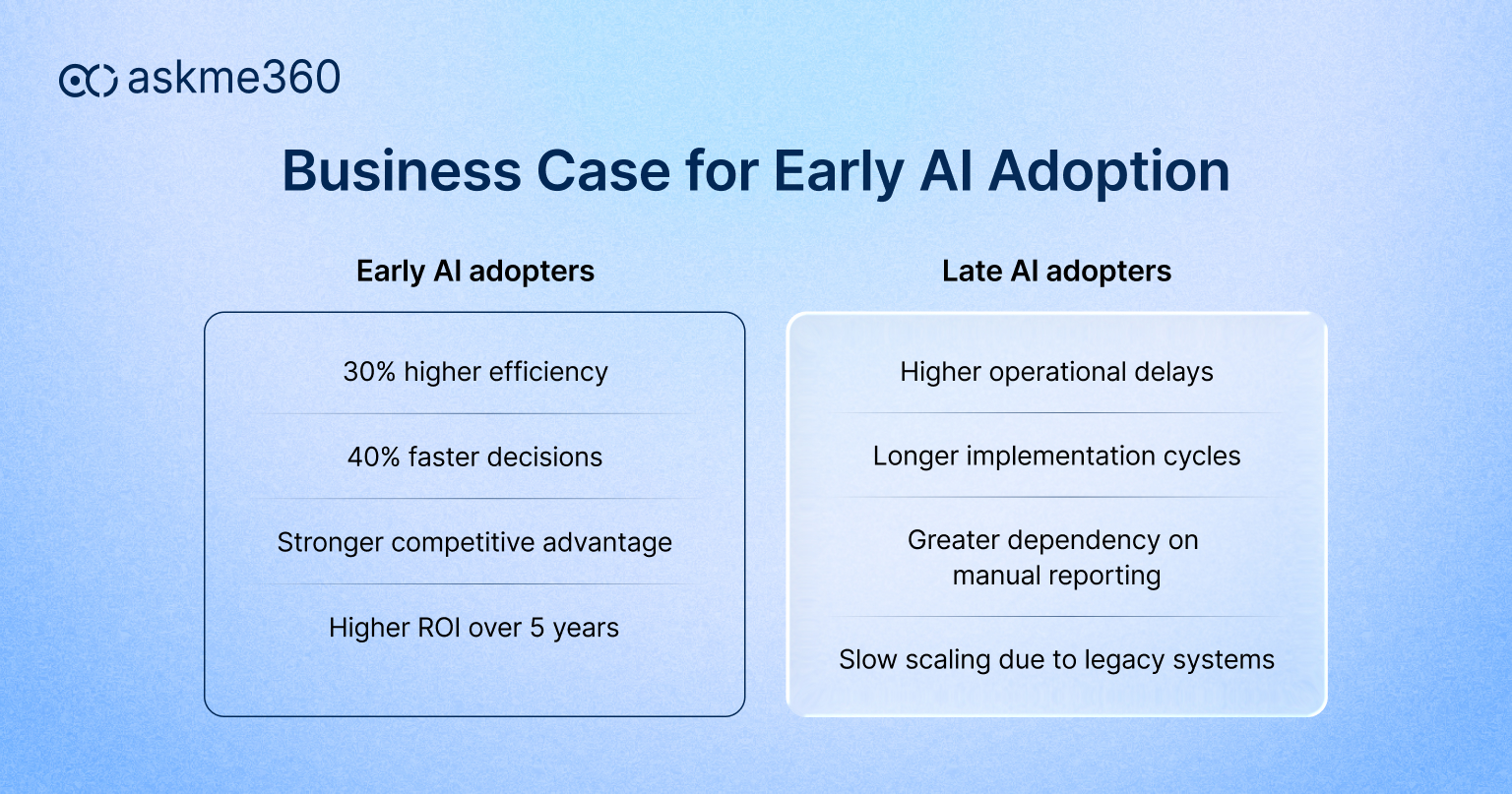
This is where early AI adoption becomes transformative. It shifts businesses from hindsight to foresight. According to a recent McKinsey global survey, companies that adopt AI early achieve up to 30% improvement in operational efficiency, 25% increase in decision-making speed, and 40% higher ROI on digital investments. Those who delay, spend more time and more resources simply catching up.
Early adoption is not about technology maturity; it’s about business maturity.
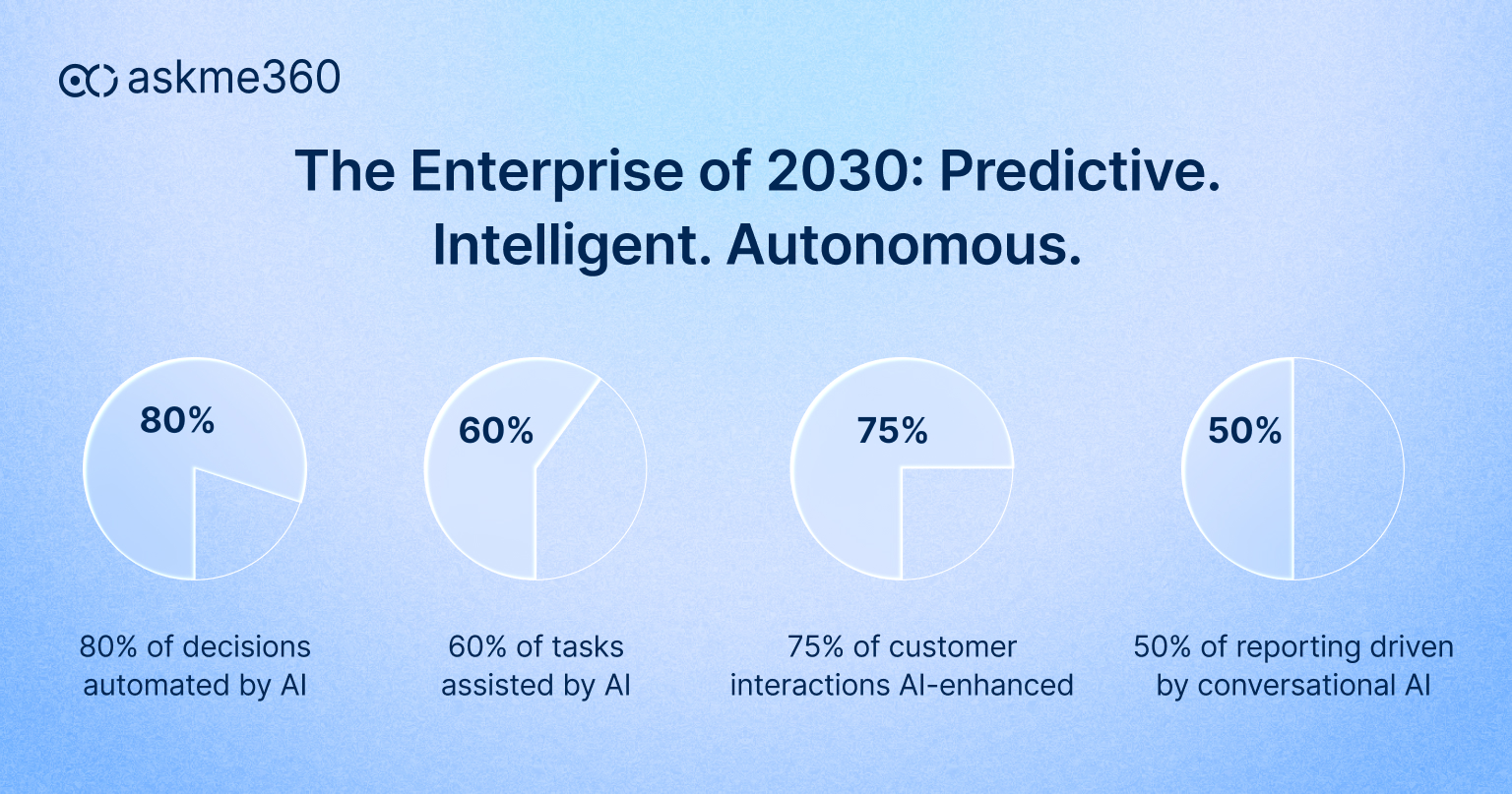
Why do early AI adopters move faster than others?
One of the most powerful outcomes of early AI adoption is the acceleration of decision-making. Enterprises today lose an estimated 35,000 human hours every year simply waiting for the right data to make decisions. This delay slows execution and dilutes strategic clarity.
AI adoption isn’t about replacing roles or overhauling systems. It’s about quietly, steadily weaving intelligence into the everyday fabric of how your business thinks, works, and decides.
- It means your teams stop navigating spreadsheets and start navigating insights.
- It means your ERP becomes conversational, proactive, and predictive.
- It means your leaders don’t wait for reports, they ask questions and get instant answers.
- It means your organisation doesn’t fear change, it reads change, anticipates it, and moves first.
Early adopters eliminate that drag completely. With enterprise AI embedded across key processes, these businesses:
- analyse data in seconds, not weeks
- reduce dependency on static reporting
- identify patterns earlier
- act on insights at the speed of change
This shift is subtle at first, but powerful in its impact. Over time, AI stops being a project and starts becoming a core business capability.
And early adopters develop this capability years before others even begin. Over time, speed becomes their cultural DNA. And in a world where advantage is measured in how fast you adapt, this becomes a defining strength. But speed is only one piece of the transformation.
AI business transformation
Traditional business intelligence tools show you what happened. AI shows you what will happen next, and why. That’s the difference between reacting and leading. When businesses adopt artificial intelligence early, everything becomes more intelligent:
- Forecasts become more accurate because AI can analyze thousands of variables humans simply cannot.
- Operations become more predictable because patterns in supply, inventory, maintenance, energy usage, and customer behaviour surface early.
- Cost structures become clearer because AI highlights inefficiencies invisible to traditional tools.
- Risk becomes manageable because AI can detect anomalies long before they evolve into costly failures.
Harvard Business Review reports that enterprises using AI for predictive intelligence have reduced operational breakdowns by nearly 45% and improved resource allocation by up to 35%. This is the real power of early adoption, you give your organisation time to learn, adapt, and evolve into an intelligence-led enterprise.
Early adopters also gain something far more valuable than technology, and that is leadership readiness. AI changes how leaders behave, how they read the business, how they plan, how they respond to uncertainty, and how they communicate with teams. When AI becomes part of decision-making early, leaders begin to rely less on assumptions and more on intelligent evidence.
This shift is what analysts call an AI leadership strategy, the ability to use AI’s insights to drive strategic direction. The sooner leaders adopt AI, the sooner the entire organisation develops a forward-looking mindset.
AI adoption benefits
A common myth is that AI is difficult to scale. But the reality is simpler, the difficulty multiplies only when you adopt late.
Late adopters often struggle with technical debt, cultural resistance, fragmented data, and entrenched legacy processes. Early adopters, on the other hand, build AI readiness gradually:
- Their teams grow comfortable with AI-driven insights.
- Their systems evolve to integrate more data sources.
- Their processes become more automated and responsive.
- Their governance frameworks harden over time.
AI becomes part of the organisational rhythm. Scaling becomes natural, not disruptive. That’s why Gartner predicts that 70% of AI value in enterprises will come from leaders who invested early, not those who rushed in late.
Strategic steps for successful AI adoption
AI adoption doesn’t succeed by accident. It succeeds with clarity, intent, and the right starting point. Many businesses rush toward AI expecting instant transformation, only to slow down due to unclear goals or disconnected efforts. The truth is that successful AI adoption is less about technology and more about strategy. When you align AI initiatives with real business outcomes, choose the right use cases, and empower your teams early, AI becomes a growth catalyst and not an experiment.

1. Define clear goals
Start with specific business challenges you want to solve (e.g., “reduce customer churn” or “optimize inventory management”) rather than broadly implementing AI for its own sake.
2. Invest in infrastructure and talent
Ensure you have the necessary IT infrastructure to support AI technologies and invest in training employees or hiring experts who can manage and leverage these new systems.
3. Start small, then scale
Begin with pilot projects to demonstrate AI’s value. Lessons learned from successful initial implementations can then be used to scale AI adoption across the entire organization effectively.
By strategically adopting AI early, businesses position themselves not just to survive, but to thrive in the future market.
Early AI adoption powers transformation across every function
When enterprise AI is introduced early enough, its benefits ripple across the business, touching finance, operations, procurement, supply chain, HR, energy management, customer service, and even compliance.
- Finance teams begin forecasting more accurately.
- Operations teams prevent unplanned downtime.
- Procurement teams identify vendor bottlenecks sooner.
- HR teams track attrition risks with greater precision.
- Energy teams optimise usage patterns and reduce waste.
Artificial intelligence in business doesn’t just support transformation but also accelerates it. And early adopters enjoy this acceleration years before the rest of the market.
Adopt and adapt to the future-ready operational model
Imagine your business operating with clear foresight, automated intelligence, and minimal friction. Imagine every workflow being more informed, every department more aligned, every decision more precise.
This is the future of business with AI, a future defined by:
- Intelligent dashboards that evolve in real time
- Proactive alerts replacing reactive firefighting
- Automated scheduling, reporting, and anomaly detection
- Predictive insights guiding investments and resource planning
- Cross-functional clarity that eliminates blind spots
- Seamless collaboration across digital and physical operations
The more you adopt early, the more your organisation begins to function like an autonomous enterprise, intelligent, efficient, scalable. And this transformation gives you a permanent competitive advantage.
The moment to start is already here
Waiting for AI to become “simpler”, “cheaper”, or “more mature” is no longer a strategic decision. It is a strategic risk. Your competitors are experimenting. Regulators are modernizing. Customers are expecting personalized, fast experiences. Employees are gravitating towards intelligent workplaces. Data is expanding at a rate no traditional system can manage. The window for early AI adoption is open now, and it is closing faster than many leaders realize.
AI is not a future technology. It is today’s most powerful driver of growth, efficiency, and competitive differentiation. Businesses that adopt AI early become more intelligent, more predictive, and more resilient.
- They develop better leadership instincts.
- They scale faster.
- They adapt quicker.
- They innovate more consistently.
Most importantly, they get ahead and stay ahead. Early AI adoption is not a trend. It is the foundation that will define the next generation of industry leaders.
If you want your organisation to operate with clarity, confidence, and speed, the journey needs to begin now. The businesses that move early will shape the future. The ones that wait will follow it.
askme360 - Your fastest route to practical AI adoption
If you want to bring AI into your business without long deployments or complex restructuring, askme360 is built exactly for you. It is an enterprise-ready AI agent that turns your ERP into a conversational, intelligent, and real-time decision system.
No dashboards. No delays. No dependency on analysts. askme360 integrates directly with Oracle EBS and PeopleSoft, automates your reporting, strengthens decision-making, and accelerates your AI adoption journey. It gives you the intelligence your business needs today and the foresight your leadership needs for tomorrow.
If early AI adoption is your growth strategy, askme360 is your launchpad.
2 Responses