Artificial Intelligence has become a strategic driver of enterprise performance. Across industries, leadership teams are now seeking answers to this very practical question.
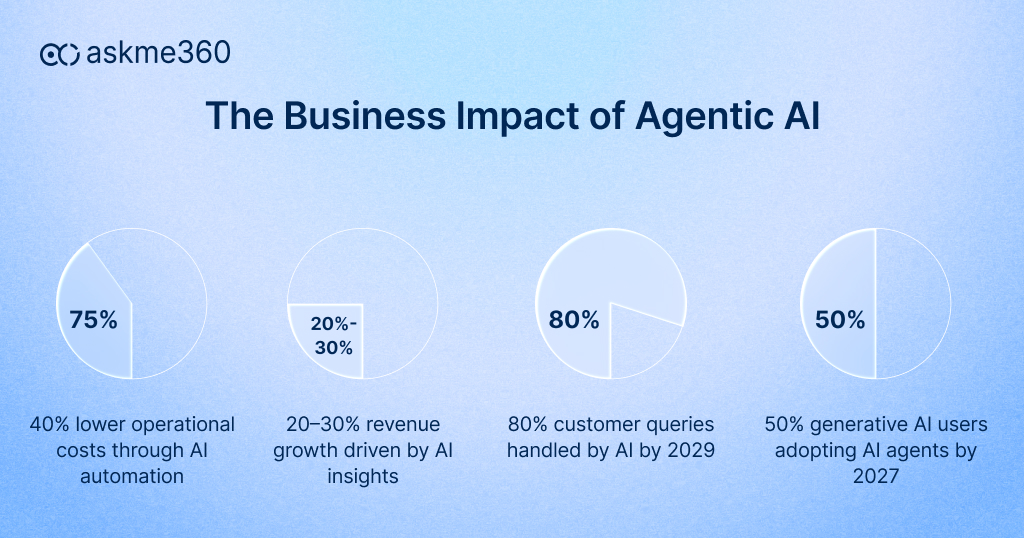
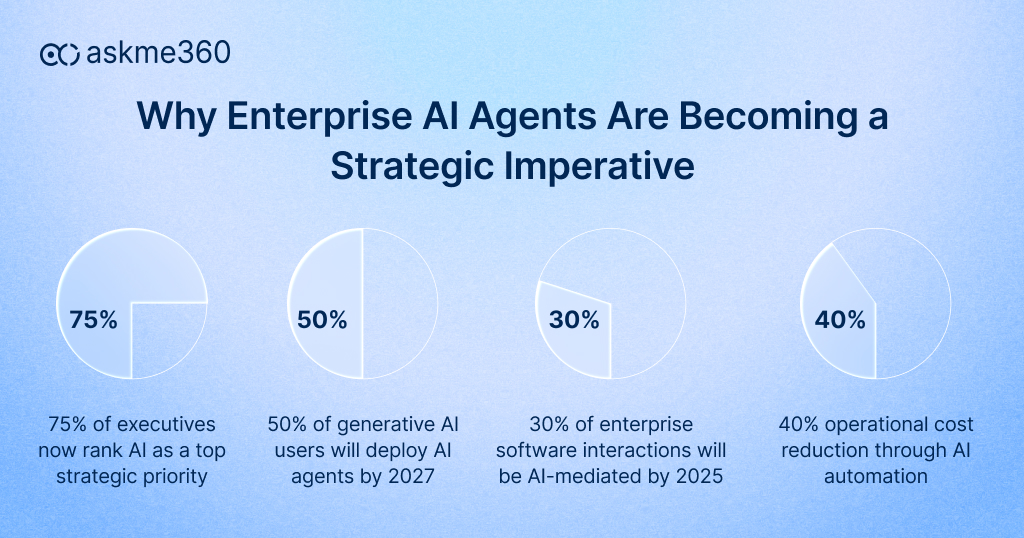
According to industry estimates, 75% of executives now consider AI a top strategic priority, yet only a small portion of organizations have successfully translated AI investments into clear business ROI. The gap often exists because companies deploy isolated AI tools rather than integrated systems that transform how decisions are made.
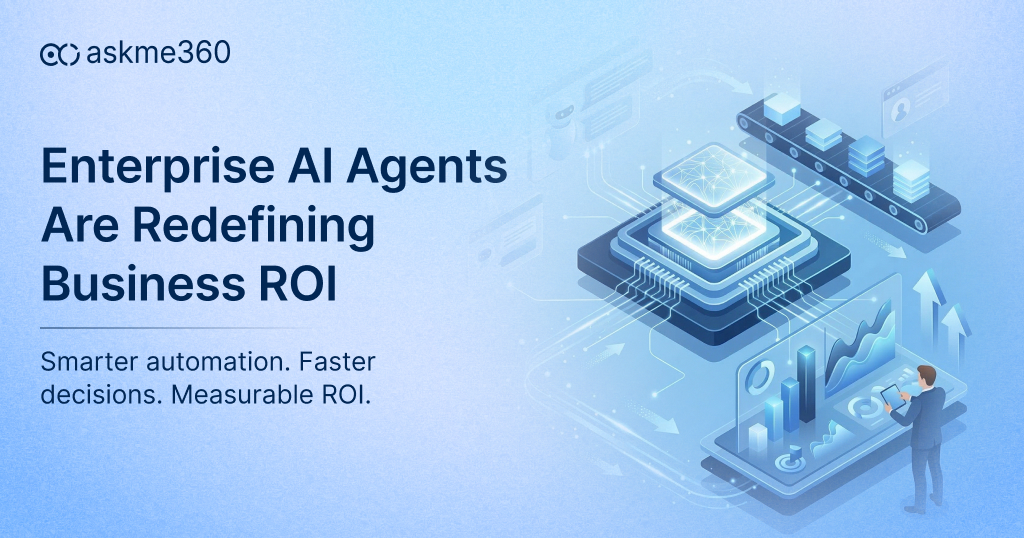
Enterprise AI agents are designed to close that gap. By connecting enterprise data, processes, and intelligence, they help organizations move from data accumulation to actionable real-time enterprise insights and measurable returns.
Let’s explore how these systems are reshaping business economics.
Modern organizations generate enormous volumes of data every day, from ERP systems, CRM platforms, finance systems, HR tools, and operational databases.
However, most enterprises face the same problem:
- Data exists in multiple systems
- Reports take days to prepare
- Managers depend on analysts for insights
In fact, enterprises often lose tens of thousands of productive hours every year just waiting for the right data to make decisions. This is where enterprise AI agents change the game. They remove the delay between data → insight → decision.
Unlike traditional AI tools that simply analyze data or generate reports, enterprise AI agents can reason, plan, and act autonomously across business systems. They automate workflows, interpret enterprise data, and surface real-time enterprise insights. As a result, organizations are beginning to see measurable gains in productivity, operational efficiency, and decision speed.
Understanding Agentic AI for Enterprises
Modern enterprises generate enormous volumes of data every day. ERP systems, CRM platforms, HR tools, supply chain systems, and operational databases constantly produce information.
However, access to insights remains surprisingly slow. In many organizations, decision-making still depends on:
- Manual reporting
- Static dashboards
- Analysts compiling insights from multiple systems
This process can take days. In fast-moving markets, those delays carry real financial costs. Enterprise AI agents address this problem by creating AI integration with enterprise systems. They are powered by a concept called Agentic AI for enterprises. This new AI paradigm goes beyond traditional automation.
Traditional AI systems are reactive. They respond to inputs and generate outputs. Agentic AI, on the other hand, can reason, plan, and execute multi-step actions autonomously.
These systems have several defining characteristics.
- They operate with a high level of autonomy. AI agents can complete tasks without continuous human supervision.
- They demonstrate reasoning and planning. Instead of simply executing commands, they evaluate context and determine the best course of action.
- They continuously learn from feedback and data patterns. Over time, their decision-making improves.
- Enable AI integration with enterprise systems such as ERP, CRM, finance platforms, and supply chain tools.
The result is a digital workforce capable of handling both data analysis and operational decision support.
How do Enterprise AI Agents Improve Business ROI
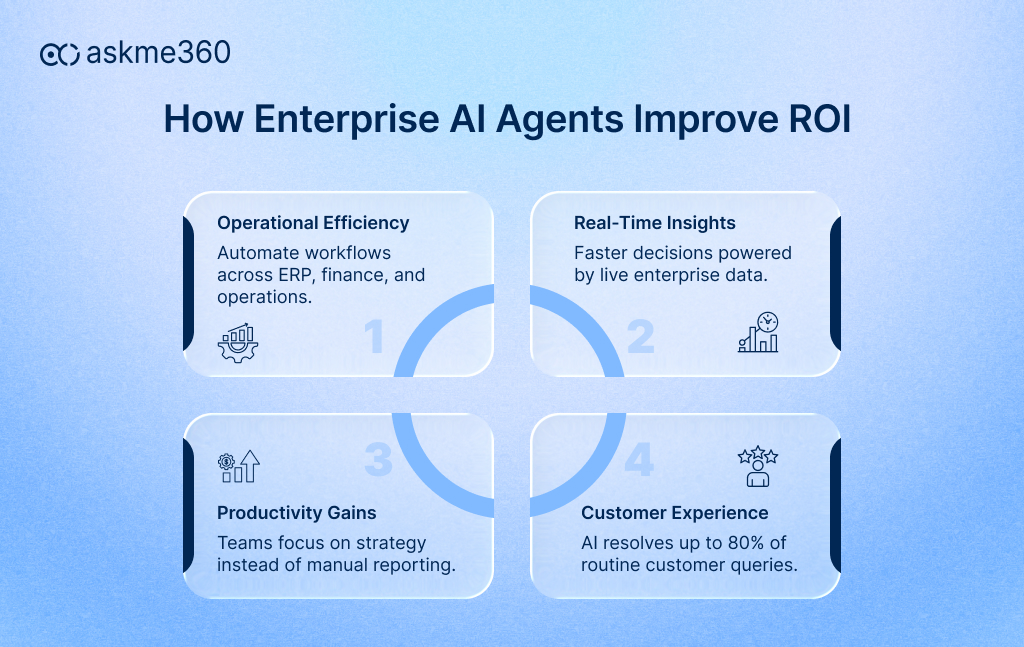
The most compelling argument for enterprise AI adoption is the impact on financial performance. Organizations implementing AI-driven automation and decision intelligence are seeing measurable improvements in several areas.
Cost Reduction Through Automation
Agentic AI can significantly reduce operational costs. Studies suggest that organizations deploying AI agents can achieve up to 40% reduction in operational costs through automation and process optimization.
Tasks that previously required hours of human effort, such as data analysis, reporting, and process monitoring, can now be completed automatically. This allows employees to focus on strategic work instead of repetitive administrative tasks.
Revenue Growth Through Data Intelligence
Enterprise AI agents also contribute to revenue growth. Companies using AI-driven analytics often see 20–30% revenue improvement through better customer insights, dynamic pricing strategies, and targeted marketing campaigns.
AI agents can analyze customer behavior patterns and identify emerging market opportunities that traditional analytics may overlook. In simple terms, they help businesses discover revenue opportunities faster.
Productivity Gains Across the Workforce
AI agents improve employee productivity by removing bottlenecks in information access. Instead of searching for data across multiple systems, employees can interact directly with AI-driven interfaces that provide instant answers.
For example, a finance manager might ask, “What are the top five cost drivers this quarter?”
Within seconds, the AI agent analyzes financial data and produces a clear summary. These small efficiency improvements accumulate across the organization and create large-scale productivity gains.
Key Strategic Impacts on ROI
The financial impact is equally compelling. Organizations adopting Agentic AI for enterprises are already reporting stronger productivity, faster planning cycles, and improved customer experiences. As these systems mature, the connection between intelligent automation and AI-driven enterprise ROI will become even clearer.
However, the real transformation lies beyond cost savings. Enterprise AI agents enable businesses to become more responsive, adaptive, and insight-driven. They help leadership teams move from reactive decision-making to proactive strategy.
1. Immediate Cost Optimization & Efficiency
- Automation of Routine Tasks – Agents handle repetitive, high-volume tasks like data entry, invoice processing, and ticket triage, reducing operational overhead and labor costs.
- Elastic Scaling – Agent-based systems scale automatically during peak times without requiring additional hiring or overtime pay.
- Improved Accuracy – Automated, 24/7 operations reduce manual errors, lowering costs related to rework, compliance breaches, or data inconsistencies.
2. Accelerated Revenue Generation
- Enhanced Customer Experience (CX) – Proactive agents provide 24/7 service, reducing response times from minutes to seconds, which boosts customer loyalty and reduces churn.
- Personalization & Sales – Sales AI agents analyze behavior, qualify leads automatically, and offer personalized recommendations, leading to a 2x–5x faster response time and higher average order values.
- Revenue Optimization – In e-commerce, AI agents handle cart abandonment recovery and dynamic pricing, resulting in higher conversion rates.
3. Long-Term Strategic Value
- Compounding Intelligence – Unlike traditional software, AI agents learn from data over time, increasing accuracy (e.g., fraud detection systems can improve by 15–25% annually).
- Data-Driven Decision Making – Agents synthesize data from disparate, legacy systems to provide real-time enterprise insights for executives, replacing slow, manual reporting.
- Reduced Risk & Compliance – Autonomous agents ensure adherence to regulatory standards by monitoring in real-time, preventing financial penalties.
By 2026, 40% of enterprise applications are expected to feature task-specific AI agents, up from less than 5% in 2025.
How do Enterprise AI Agents Improve Operational Efficiency
Operational efficiency is where the impact of AI agents becomes most visible. Consider how enterprises traditionally manage cross-functional processes. A typical workflow, such as employee onboarding or procurement, often involves multiple departments and software systems. Without automation, these processes create delays and coordination challenges.
Enterprise AI agents solve this problem through intelligent workflow orchestration. For example, an AI agent managing employee onboarding can automatically:
- Trigger HR documentation workflows
- Provision IT access
- Schedule training sessions
- Monitor compliance tasks
All of this happens without manual intervention.
Similarly, in supply chain management, AI agents can continuously monitor inventory levels, supplier performance, and logistics data. When potential disruptions appear, the system recommends corrective actions immediately.
This level of automation creates operational efficiency with AI that traditional workflow tools cannot achieve.
Transforming Customer Experience with AI Agents
Customer experience is another area where AI agents are delivering strong AI-driven enterprise ROI. Modern customer engagement spans multiple channels, from email, chat, social media, support platforms, and CRM systems. Managing these interactions manually can overwhelm service teams. Enterprise AI agents integrate these systems and create a context-aware customer engagement environment.
For example, an AI agent can:
- Analyze customer interaction history
- Detect unresolved issues
- Escalate high-priority cases
- Personalize communication automatically
As a result, response times improve and customer satisfaction increases. Industry projections suggest that by 2029, AI systems could handle up to 80% of common customer service queries without human intervention. This dramatically lowers operational costs while improving service quality.
Strengthening Enterprise Security and Compliance
Another major benefit of enterprise AI agents is improved security. Modern enterprises operate in a highly regulated environment. Compliance requirements such as GDPR and data privacy regulations require constant monitoring. AI agents can monitor systems continuously for anomalies, suspicious activity, and policy violations.
For example, AI-driven security agents can detect unusual access patterns or abnormal transaction behavior in real time. This reduces the risk of fraud and data breaches.
Additionally, automated compliance monitoring ensures that organizations remain aligned with regulatory frameworks without relying solely on manual oversight.
What is the Future of Enterprise Decision Intelligence
Looking ahead, enterprise AI agents will become central to how organizations operate. Analysts predict that by 2027, half of companies using generative AI will deploy AI agents to support business operations. As these systems evolve, they will not only answer questions but also proactively recommend decisions, predict risks, and automate strategic workflows.
In essence, enterprise AI agents will act as digital analysts, advisors, and operators working alongside human teams. For business leaders, this represents a fundamental shift in how organizations generate value from data. The result is measurable AI-driven enterprise ROI, not as a theoretical promise, but as a practical business outcome. Organizations that embrace Agentic AI for enterprises today will be better positioned to compete in an increasingly data-driven economy.
How does askme360 impact enterprise decisions?
For over three decades, Heuristics Informatics Pvt. Ltd. (HIPL) has helped enterprises modernize technology landscapes and unlock the true value of their data. Today, as businesses generate massive volumes of information, the challenge is no longer data availability, it is turning that data into timely, actionable insights.
askme360, HIPL’s AI-powered enterprise platform, addresses this challenge through intelligent Enterprise AI Agents. It allows business leaders to ask questions in natural language and instantly receive real-time enterprise insights from ERP and operational systems. By enabling seamless AI integration with enterprise systems, askme360 helps organizations accelerate decision-making, improve operational efficiency with AI, and achieve measurable AI-driven enterprise ROI.
With askme360, HIPL is helping enterprises move beyond dashboards, toward a future where Agentic AI for enterprises transforms data into decisions and decisions into competitive advantage.