Be it sales figures, supply chain movements, customer behavior, or energy consumption patterns, data now sits at the center of every decision. No matter which department you are leading… be it finance, operations, HR, procurement, or energy management, you already know how deeply your teams depend on accurate information to make decisions. However, business leaders finally acknowledge that data may be abundant, but access to insights is still painfully slow.
In this blog, let’s explore how data democratization is transforming the way businesses operate, why it matters today, and how AI will shape the future of decision-making.
What is data democratization?
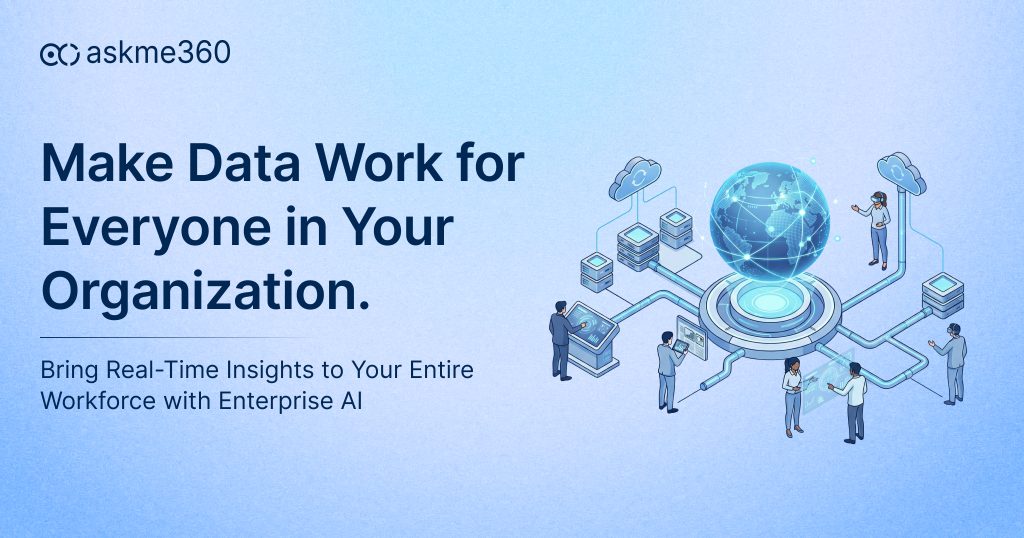
Data democratization means making data accessible to everyone in your organization, not just analysts, IT teams, or the finance department.
In traditional setups, data sits locked inside ERP systems, BI dashboards, and complex reports, reachable only by people who know how to extract it.
Data democratization removes those barriers. It gives every employee the ability to find, understand, and use data whenever they need it, securely and responsibly.
Think of it as shifting from:
- “Ask IT to extract this report”
to
- “I can get the answer myself in seconds.”
What does data democratization mean in the age of AI?
Traditionally, data democratization meant giving more people access to dashboards and analytics tools. But adoption was low because tools were complex and required training.
With AI:
- Employees can ask questions in natural language
- Insights come instantly, without coding or BI expertise
- Data becomes conversational, not technical
- Patterns and anomalies are detected automatically
- Predictions and recommendations appear proactively
AI turns democratized data into something far more powerful. Insight accessible to everyone, at the speed of thought.
This is a new era, one where every employee becomes data-enabled, not just analysts.
The pillars that make data democratization work
Before data democratization can deliver real impact, your business needs a strong foundation. These pillars ensure that data is accessible, reliable, and usable for every team that depends on it.
Modern data architecture
Before democratizing data, you need a structured data foundation. This includes:
- Data lakes
- Data warehouses
- Cloud storage
- Data pipelines
- Metadata management
- Data governance
This ensures that your information is accurate, unified, and secure.
Self-service analytics
Self-service analytics tools make it possible for non-technical teams to explore and visualize data without coding. These tools simplify:
- Trend analysis
- KPI tracking
- Reporting
- Forecasting
- Segmentation
Here, usability is the key. If tools feel complicated, users won’t adopt them.
Data literacy
Data democratization works only when people understand how to read and interpret data.
Data literacy includes:
- Understanding dashboards and KPIs
- Interpreting charts
- Spotting trends
- Asking the right questions
- Using insights for decision-making
Organizations investing in data literacy see much higher adoption of business intelligence tools.
Why democratizing data has become a business imperative
Data generation is skyrocketing. IDC predicts the global datasphere will explode to 175 zettabytes by 2025, a fivefold increase from 2018. But while businesses are flooded with data, only a small percentage is used for decision-making.
The reason? Most employees still don’t have direct access to insights. Requests pile up with analytics teams. Dashboards remain underutilized. And leaders continue to make decisions based on partial or outdated information.
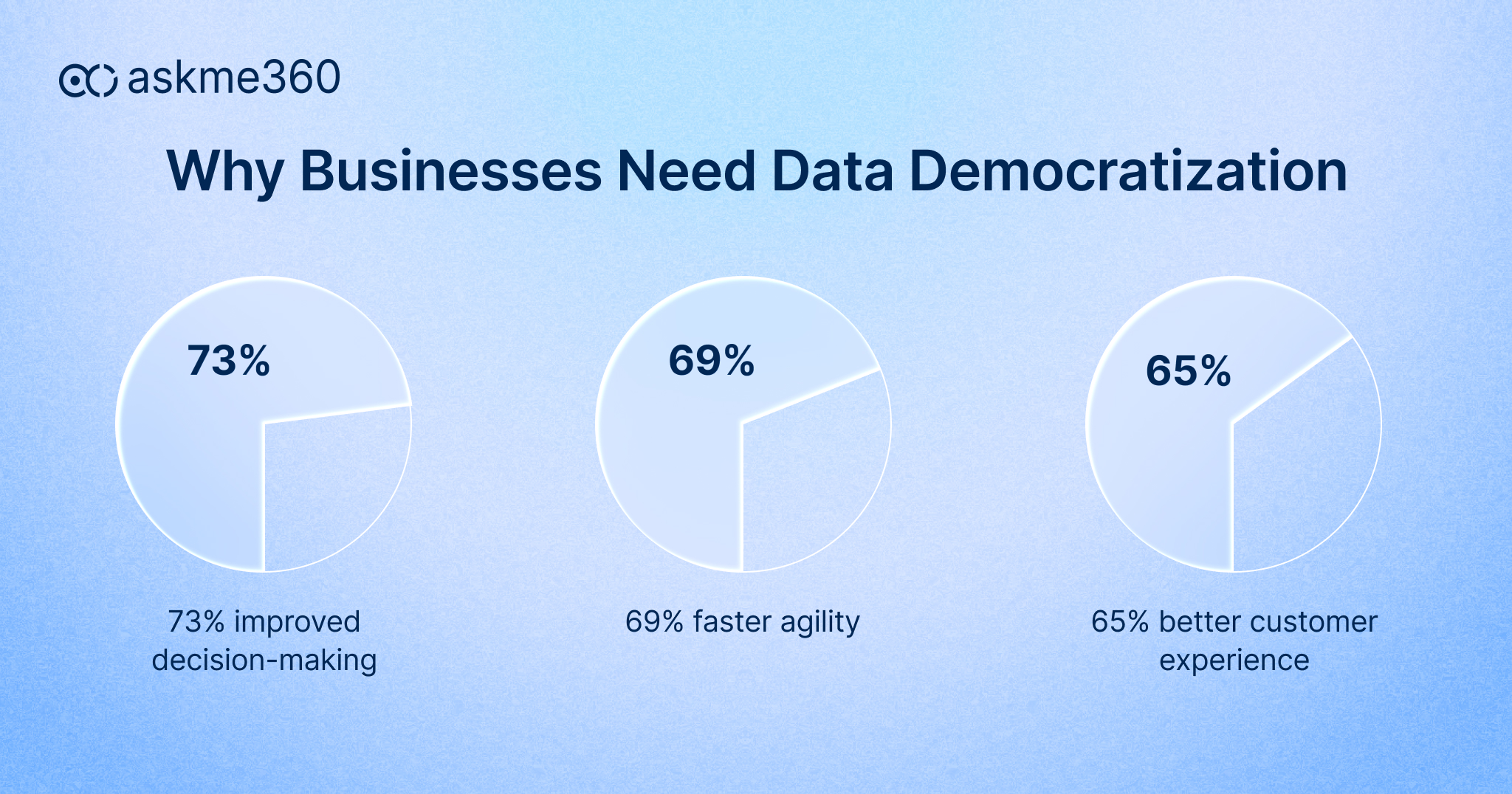
Yet, organizations that democratize data see significantly better outcomes. Studies show:
- 73% say democratized data improves decision-making
- 69% see faster response to market changes
- 65% report better customer experiences
But democratizing data at scale has always been difficult, until AI arrived.
Reasons why businesses can’t ignore this shift
Let’s look at the real reasons driving the rise of data democratization:
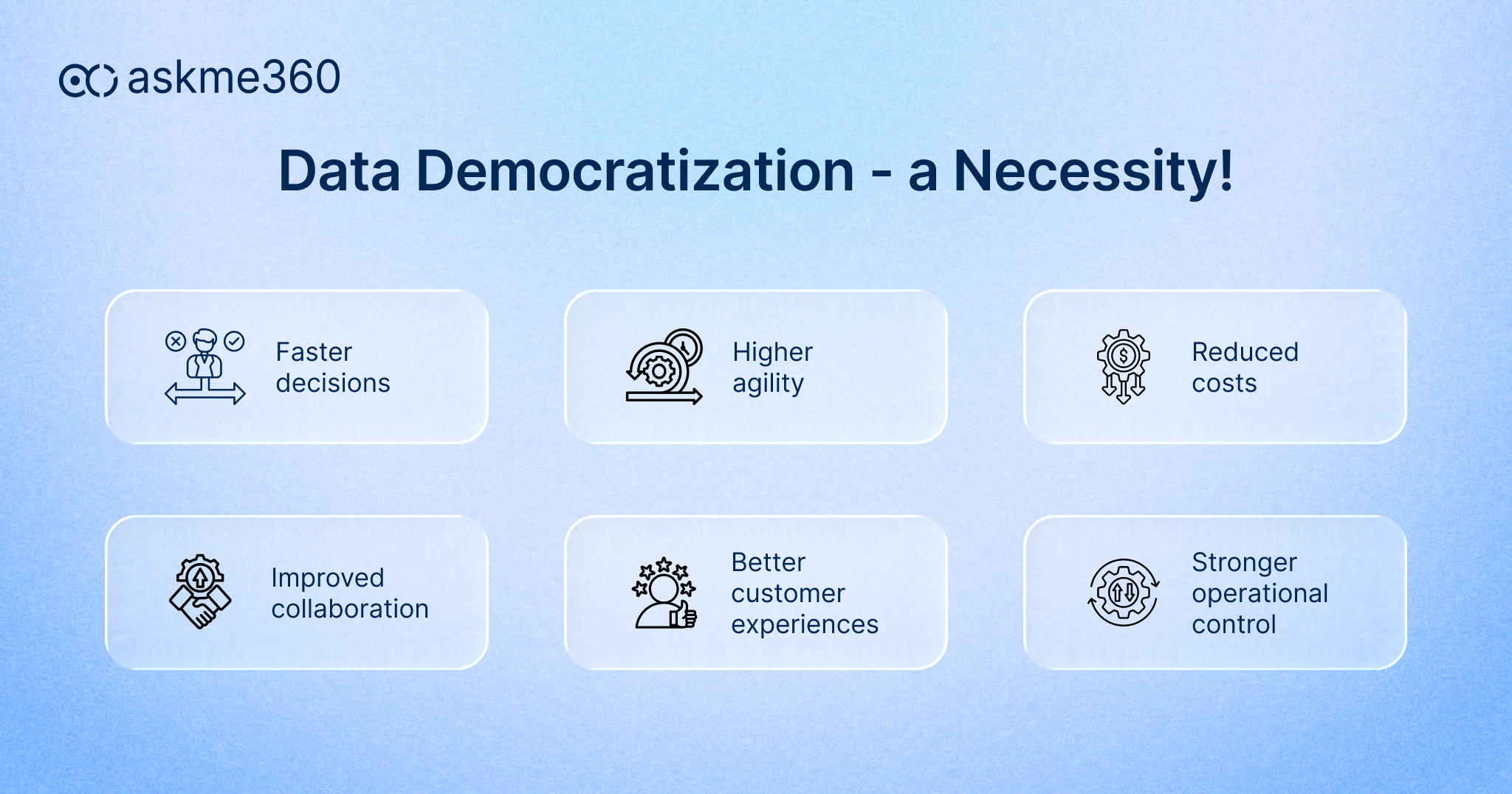
The pressure to move faster
Your competition isn’t slowing down. Markets shift quickly. Customers expect quicker responses. Leaders need real-time visibility across operations.
Data democratization helps teams make decisions in seconds, not days.
Higher complexity in business processes
From supply chains to finance to plant operations, processes have become more interconnected. Centralized decision-making slows everything down.
Giving people access to their own data simplifies operational workflows dramatically.
Avoiding “data bottlenecks”
Most organizations rely on small analytics teams. But when data requests from HR, sales, operations, and finance pile up, the delays become painful.
Democratizing data eliminates unnecessary bottlenecks.
Rising demand for personalization
From retail to manufacturing, customers expect personalized, responsive experiences. Teams need data access to track preferences, performance, and patterns in real time.
Preparing for the AI-driven future
Enterprise AI relies on clean, accessible, labeled data. If data stays locked away, organizations can never fully leverage Enterprise AI Solutions.
Data democratization lays the foundation for AI maturity.
Why AI makes democratization truly scalable
Earlier attempts at democratization always had a ceiling. Too many tools, too much training, too many dependencies.
AI removes those limits by:
- Automating analysis
- Automating reporting
- Automating data cleaning
- Automating visualization
- Automating interpretation
- Automating predictions
In short, AI turns democratization from a process into an experience.
Employees don’t think about “accessing data”. They simply think about asking a question. And the system handles everything else.
The future of enterprise decision-making
As more businesses adopt Enterprise AI, data democratization will go from “important initiative” to “core business function.”
Leaders already recognize this shift:
- 40–50% higher analytics adoption with AI-enabled systems
- 32% higher operational efficiency through data accessibility
- 20–30% higher customer satisfaction with real-time insights
The organizations that move early will have a huge advantage, faster decisions, clearer visibility, and deeper intelligence across operations. Organizations that embrace AI-driven democratization today will lead in innovation, responsiveness, and operational excellence tomorrow.
askme360 makes data democratization effortless
askme360 is built to make democratization seamless and instant. It connects directly to ERP systems like Oracle EBS and gives your teams the power to access insights through natural language, not dashboards or BI tools.
askme360 responds within seconds with charts, reports, and actionable insights, supercharged by Enterprise AI.
With askme360, data democratization becomes effortless, secure, and truly intelligent, enabling your entire organization to move faster, think smarter, and operate proactively.